Pharmaceutical Pen Testing: Why R&D and GxP Need Different Scopes.
Contributors


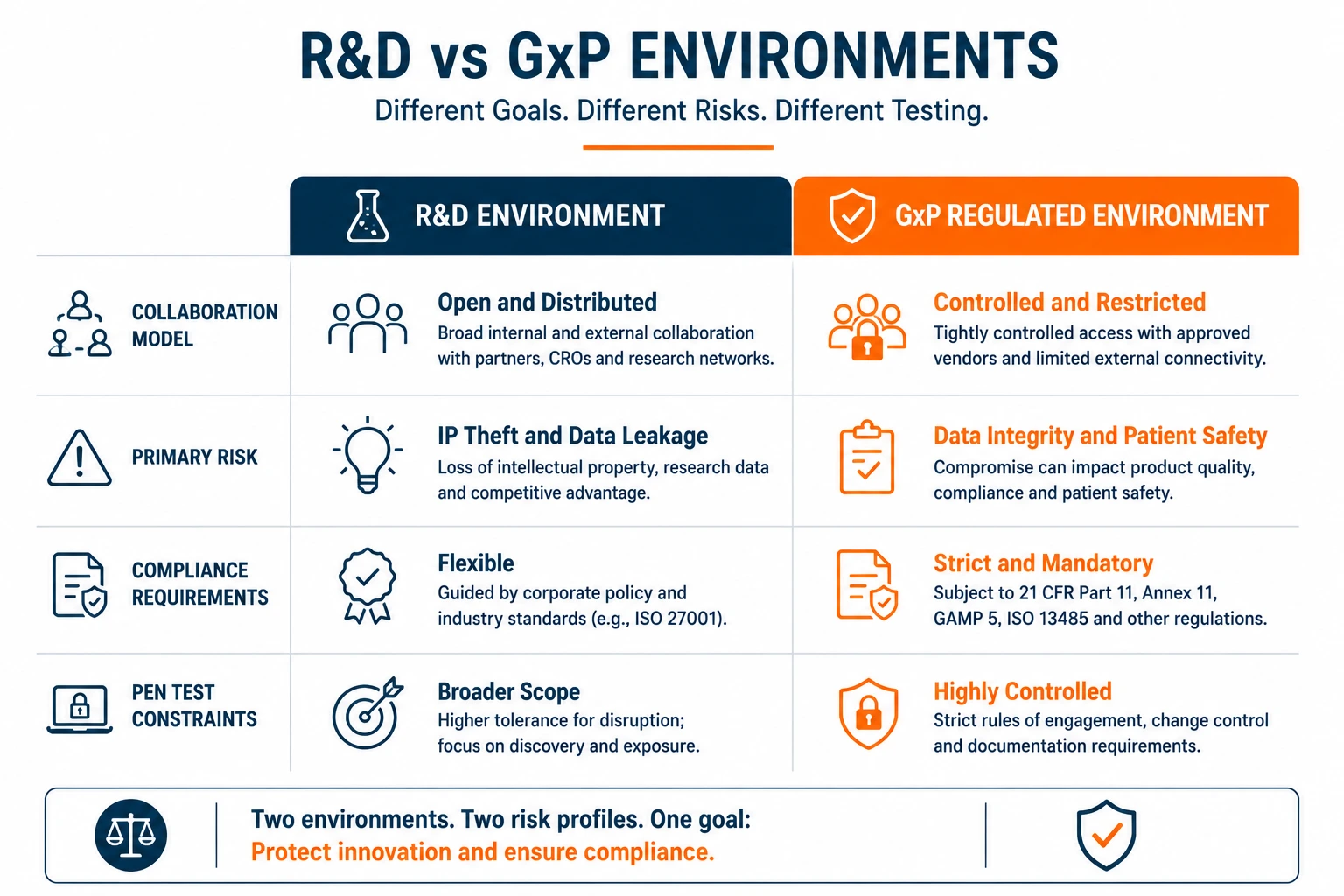
Most pharmaceutical companies have one security team managing two fundamentally different environments. The research and development (R&D) network is fast-moving, collaborative and built around researcher productivity. The GxP (good practice) regulated environment is controlled, validated and built around data integrity and auditability. These environments have different risk profiles, different compliance requirements and different constraints on how security testing can be conducted. Treating them with a single unified pen test scope produces results that serve neither environment well.
What Makes the Environments Different
The R&D environment is characterized by external collaboration. Researchers share data with academic partners, contract research organizations (CROs) and external collaborators. Cloud platforms are used for data storage and computational work. Mobile access is common. The primary risk is intellectual property (IP) theft, and the threat model centers on unauthorized access to high-value research data by external actors, whether criminal or state-sponsored.
The GxP regulated environment is characterized by validation and control. Systems are qualified, changes go through formal change control, and the integrity of electronic records is a regulatory requirement, not just a security objective. The primary risk is data integrity compromise, and the threat model includes both external attackers and insiders with legitimate system access. Testing in this environment has consequences that testing in R&D does not: an uncontrolled change to a validated system may require revalidation before it can be used for regulated activities. Regulators treat data integrity as a primary failure mode: data integrity deficiencies were cited in 79% of US Food and Drug Administration (FDA) drug good manufacturing practice (GMP) warning letters in fiscal year 2016 and 57% in fiscal year 2018.
Scoping for R&D
...is built around the data that matters: electronic lab notebooks, laboratory information management systems (LIMS), computational chemistry platforms, genomics data repositories and the collaboration tools that connect internal researchers to external partners. The methodology is standard for each system type, but the focus is on the paths that reach the most valuable data and the external access points that those paths expose.
Third-party and CRO access is the highest-priority area in most R&D scopes. The access that external research partners require is often broad, poorly documented and rarely reviewed after initial setup. Testing what a compromised CRO credential can reach inside the pharma environment consistently produces findings that surprise security teams who assumed the access was narrower than it is. The risk is not theoretical. In 2019, Charles River Laboratories, one of the largest contract research organizations, disclosed in a US Securities and Exchange Commission filing that a highly sophisticated, well-resourced intruder had copied data belonging to about 1% of its clients.
Scoping for GxP Regulated Systems
A GxP pen test scope requires a layer of planning that R&D scoping does not. Before any system is included in active testing, its validated state needs to be documented, and a qualified test environment needs to be established. Testing in production is not an option for validated systems. The risk of an uncontrolled change to the system, the data or the audit trail is too high, and the remediation of such a change, through revalidation, is far more expensive than the cost of setting up a proper test environment.
The scope document for GxP testing needs to specify, for each system, the validation status, the test environment approach, the change control documentation required before and after testing, and the criteria for what constitutes an acceptable finding versus one that requires immediate escalation to the validation team. This is more detailed than a standard pen test scope document, and it should be reviewed and approved by both the security team and the validation lead before the engagement starts. The validation expectations trace to 21 CFR Part 11 and EU Annex 11, which govern electronic records and computerized systems in regulated environments.
Running Both Scopes Efficiently
Running two separate pen test engagements, one for R&D and one for GxP, doubles the cost and the coordination overhead without necessarily producing better results. A single engagement with two clearly defined scope tracks, different methodologies for each track and coordinated reporting is the more efficient approach. The key is shared infrastructure. Systems that sit between R&D and GxP environments, such as identity management platforms, network infrastructure and shared file services, need to be tested in the context of both environments, not just one.
The reporting structure for a dual-scope engagement should keep R&D and GxP findings separate. The remediation process for a finding in a validated system is fundamentally different from the remediation process for a finding in R&D. Mixing them in a single findings list creates confusion about ownership and urgency that slows down remediation for both.
One engagement, two scope tracks, findings your validation team and your security team can each act on. Request a dual-track scoping session and test both environments the way each one requires.


Other Popular Articles
In the digital age, businesses must adopt an ad
GRC is the capability, or integrated collection
Get the latest insights straight from our desk to your inbox.
Other Featured Articles
Explore More
How Often Should Manufacturers Run OT Penetration Testing?
Annual pen testing fits a budget cycle but it doesn't reflect how fast manufacturing environments actually change.
Shantanoo Govilkar
SVP Strategic Solutions Risk & Cybersecurity Solutions view
Pharmaceutical Pen Testing: What 21 CFR Part 11 and cGMP Require
21 CFR Part 11 and cGMP don't mention penetration testing but the controls they require depend on it.
Shantanoo Govilkar
SVP Strategic Solutions Risk & Cybersecurity Solutions view
Pharmaceutical Pen Testing: Why R&D and GxP Need Different Scopes.
R&D and GxP regulated environments have different risk profiles, compliance requirements, and testing constraints.
Shantanoo Govilkar
SVP Strategic Solutions Risk & Cybersecurity Solutions view
Why Pharmaceutical Pen Testing Must Address Nation-State Threats
Nation-state actors treat pharma like critical infrastructure targeting formulation data, synthesis routes, and clinical IP with patience and precision.
Shantanoo Govilkar
SVP Strategic Solutions Risk & Cybersecurity Solutions view
How Ransomware Crosses the IT-OT Boundary (And How to Stop It)
Ransomware operators target the IT-OT boundary deliberately and they know manufacturing economics well.
Shantanoo Govilkar
SVP Strategic Solutions Risk & Cybersecurity Solutions view
Where Industry 4.0 Left Your OT Attack Surface Wide Open
Industry 4.0 connected OT environments were never built for. Learn why traditional IT security tools fall short and what OT penetration testing reveals that audits miss.
Shantanoo Govilkar
SVP Strategic Solutions Risk & Cybersecurity Solutions view
What AS4 Actually Solves: Real Outcomes Companies See After Migration
Discover what AS4 actually solves for modern businesses. Learn the real outcomes companies achieve after migration, from stronger security to better B2B integration performance.
EDI Solutions Group
Marketing Group view
7 Migration Pitfalls That Derail AS4 Upgrades (and How to Avoid Them)
Avoid costly AS4 upgrade mistakes. Discover 7 migration pitfalls that delay projects, create risk, and disrupt B2B messaging, plus practical ways to avoid them.
EDI Solutions Group
Marketing Group view
How to Perform Penetration Testing in Cloud Environments (AWS, Azure, and GCP) - 2026 Edition
A practical guide to cloud penetration testing across AWS, Azure, and GCP. Learn methods, tools, and best practices to identify vulnerabilities and improve security.
Cybersecurity Solutions Group
Marketing Group view
5 Signs It's Time to Move Legacy EDI Environment to AS4 Protocol
Partner onboarding delays, compliance gaps, and rising maintenance costs are signals your EDI infrastructure is reaching its limits. Learn the five signs it is time to evaluate a move to AS4.
EDI Solutions Group
Marketing Group view
How to Design Custom Chatbots That Cannot “Make Stuff Up”
Confident AI answers without traceable sources create institutional risk. Learn how Grounded RAG architecture retrieves real documents first and attaches verifiable citations to every response.
Data and AI Solutions Group
Marketing Group view
How Citation-Backed Conversational AI Improves Public Access and Internal Decision-Making
AI without source citations creates real liability. Learn how citation-backed AI brings traceable sources, version awareness, and audit-ready outputs to every institutional decision.
Data and AI Solutions Group
Marketing Group view
How to Perform a Successful Network Penetration Test: Comprehensive Guide for 2025
Learn how to perform a successful network penetration test to identify vulnerabilities, simulate real cyberattacks, and strengthen your organization’s network security.
Cybersecurity Solutions Group
Marketing Group view
What Is Penetration Testing? A 2026 Expert Guide
A 2026 expert guide to penetration testing for security leaders and IT teams seeking proactive defense, compliance, and stakeholder trust.
Cybersecurity Solutions Group
Marketing Group view
OT Ransomware Prevention: Practical Best Practices for Industrial Cybersecurity
Explore enterprise grade OT ransomware prevention strategies, including segmentation, identity control, threat informed detection, and resilient recovery design to protect industrial operations fro
Cybersecurity Solutions Group
Marketing Group view
10 Myths About OT/ICS Security That Put Your Business at Risk
Think your OT network is secure? Learn the 10 most dangerous myths about OT and ICS cybersecurity that leave industrial operations exposed to attacks.
Cybersecurity Solutions Group
Marketing Group view
OT Ransomware Risks and Response for Industrial Systems
Learn why OT environments face higher ransomware risk, how attackers gain access, and how effective detection and response reduce operational impact.
Cybersecurity Solutions Group
Marketing Group view
AI Risk Assessment: Risk Types, Best Practices & More
Explore AI risk types, essential assessment frameworks, and proven best practices to mitigate threats in AI deployment. Learn actionable strategies for secure AI systems today.
Cybersecurity Solutions Group
Marketing Group view
AI Risk Assessment: Everything You Need to Know
Learn essential processes, methodologies, risk types, regulatory requirements, and practical implementation strategies for safe AI deployment.
Cybersecurity Solutions Group
Marketing Group view
Whitepaper: Ransomware Threat Management
Ransomware continues to be a real threat to business operations across all industries, no organization is safe from this threat.
Laszlo S. Gonc
CISSP, First Senior Fellow, DivIHN Cybersecurity Center of Excellence view
Cybersecurity Incident Response Preparedness
An incident response framework provides a structure to support incident response operations. A framework typically provides guidance on what needs to be done, but not on how it is done.
Laszlo S. Gonc
CISSP, First Senior Fellow, DivIHN Cybersecurity Center of Excellence view
IoT Medical Device Cybersecurity
Healthcare data and medical devices would be aggressively targeted by ransomware attacks since early 2017 has proven to be true