
Why Pen Test Evidence Fails C3PAO Assessments (and How to Fix It)
Contributors


Passing a Certified Third-Party Assessment Organization (C3PAO) assessment is not just about having done a penetration test. It is about being able to demonstrate, through documented evidence, that the test covered the right systems, used appropriate methodology and produced findings that were assessed and addressed. Many defense contractors who have completed legitimate pen tests still struggle with C3PAO assessments because the evidence package does not match what assessors are trained to look for. The stakes are now contractual: the CMMC acquisition rule took effect November 10, 2025, and assessment requirements began entering DoD solicitations the same day.
What C3PAO Assessors Actually Do With Your Pen Test Report
A C3PAO assessor reviewing your pen test evidence is not reading it as a security professional evaluating methodology. They are reading it as an auditor looking for specific artifacts that confirm specific Cybersecurity Maturity Model Certification (CMMC) practice statements are satisfied. The question they are answering for each practice is: does this evidence demonstrate that the control was implemented and tested?
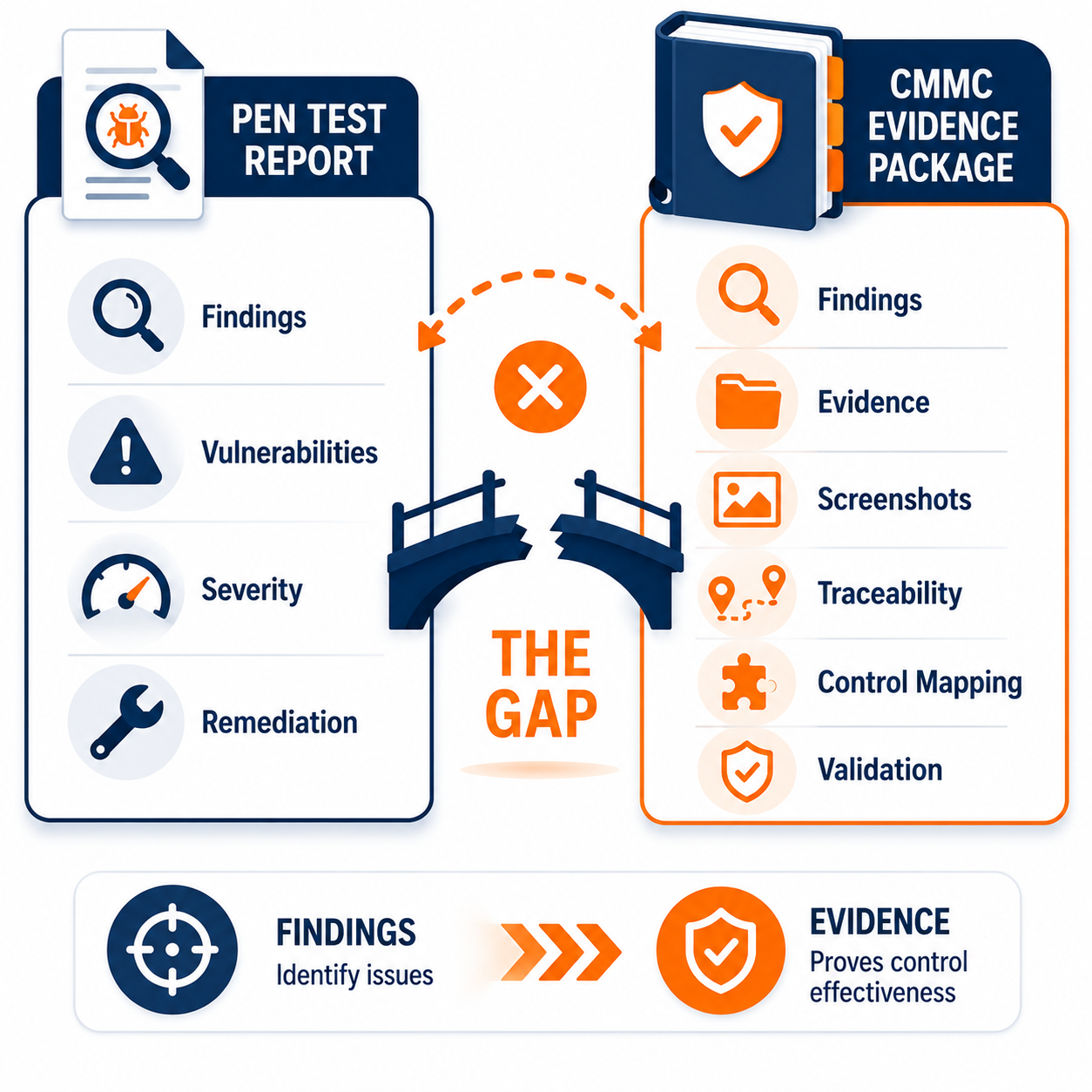
A standard commercial pen test report is written to answer a different question: what did we find and how should you fix it? The structure, language and level of detail that serves that purpose often does not map cleanly to the evidence requirements of a CMMC assessment. That mismatch is the source of most pen test evidence failures in C3PAO engagements.
Understanding the Evidence Requirements by Practice Domain
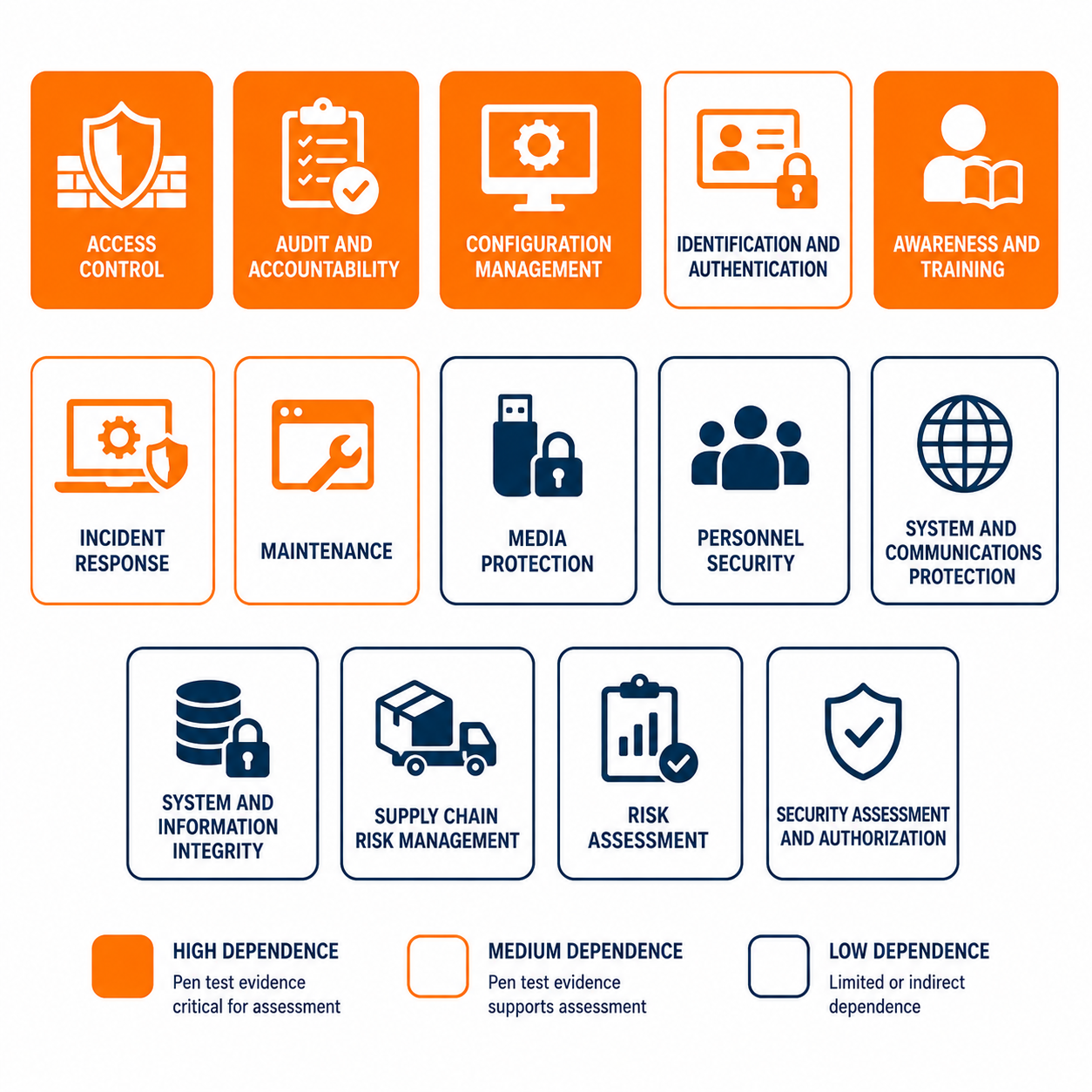
CMMC Level 2 is built on 110 practices drawn from NIST SP 800-171 Revision 2. Not all of them require pen test evidence, but several domains depend heavily on it. Access Control practices require evidence that user permissions, separation of duties and session controls were tested. Identification and Authentication practices require evidence that credential strength, multi-factor authentication (MFA) implementation and authentication bypass attempts were evaluated. System and Communications Protection practices require evidence that network segmentation was validated through actual testing, not just reviewed through documentation.
The evidence requirement for each practice specifies not just that testing occurred, but that the testing addressed the specific control the practice describes. A pen test report that documents network scanning and exploitation attempts satisfies different practices than one that specifically documents attempts to bypass MFA or cross network segment boundaries.
Building an Evidence Package That Works
The pen test report is the foundation, but it is not the complete evidence package. A C3PAO-ready submission typically includes the report itself, the scope document that defines what was tested and why, screenshots and technical artifacts from the testing that support specific findings, remediation documentation for any findings that were addressed before the assessment, and a Plan of Action and Milestones (POA&M) for findings that remain open.
Each element of the package needs to be traceable to specific CMMC practices. The scope document should reference the controlled unclassified information (CUI) boundary and the systems included in scope in language that maps to your system security plan (SSP). The findings should reference the NIST 800-171 controls they relate to. Remediation documentation should show not just that a ticket was closed but that the specific control weakness was addressed and verified.
The POA&M Connection
One of the most common evidence failures in C3PAO assessments is a disconnect between pen test findings and the POA&M. Assessors expect to see a clear line from finding to POA&M entry to remediation status. When pen test findings appear in the report but are not reflected in the POA&M, or when POA&M entries reference findings in language that does not match the report, assessors treat it as evidence of a program that is not managing its findings systematically. The regulation leaves no slack here. Under 32 CFR 170.21, a POA&M is permitted only for select lower-weighted requirements, only with an assessment score of at least 80%, and it must be closed out within 180 days or the Conditional CMMC Status expires.
Building that connection requires agreement, before the pen test engagement, on how findings will be categorized and referenced. The naming and severity conventions in the pen test report need to match the conventions in your POA&M. That alignment does not happen automatically. It requires deliberate coordination between the pen test team and the compliance team before the engagement starts.
Verifying Your Evidence Before the Assessment Window Opens
The worst time to discover that your evidence package has gaps is when a C3PAO assessor asks for a document you cannot produce. A structured review of your evidence package against the CMMC practice statements it is intended to satisfy, conducted before the assessment window opens, gives you time to address gaps, request supplemental testing from your pen test provider or document accepted risks with appropriate justification. The cost of getting compliance representations wrong is documented: in 2022, Aerojet Rocketdyne paid $9 million to settle False Claims Act allegations that it misrepresented its compliance with cybersecurity requirements in federal government contracts.
Do not let an assessor find the gaps first. Request a pre-assessment evidence review and walk into your C3PAO engagement with every artifact mapped, traceable and ready to produce.

Frequently Asked Questions
Because passing a C3PAO assessment is not about having done a pen test, it is about proving through documented evidence that the test covered the right systems, used appropriate methodology, and produced findings that were assessed and addressed. Many defense contractors complete legitimate pen tests but still fail, because their evidence package is not structured the way assessors are trained to look for it.
A C3PAO assessor reads the report as an auditor, not as a security professional evaluating methodology. For each CMMC practice, they are answering one question: does this evidence demonstrate the control was implemented and tested? A standard commercial pen test report is written to answer a different question, namely what was found and how to fix it, and that mismatch is the source of most pen test evidence failures.
A complete package is more than the report. It typically includes the pen test report, the scope document defining what was tested and why, screenshots and technical artifacts supporting specific findings, remediation documentation for findings fixed before the assessment, and a Plan of Action and Milestones (POA&M) for findings that remain open. Each element must be traceable to specific CMMC practices to satisfy an assessor.
CMMC Level 2 is built on 110 practices drawn from NIST SP 800-171 Revision 2, and several domains depend heavily on pen test evidence. Access Control practices require evidence that permissions, separation of duties, and session controls were tested. Identification and Authentication practices require evidence that credential strength, MFA, and authentication bypass attempts were evaluated. System and Communications Protection practices require evidence that network segmentation was validated through actual testing, not just documentation review.
Under 32 CFR 170.21, a POA&M is permitted only for select lower-weighted requirements, only with an assessment score of at least 80%, and it must be closed within 180 days or the Conditional CMMC Status expires. This matters because assessors expect a clear line from each pen test finding to a POA&M entry to a remediation status. When findings appear in the report but not in the POA&M, assessors read it as a program that is not managing its findings.
The CMMC acquisition rule took effect on November 10, 2025, and assessment requirements began entering Department of Defense solicitations the same day. This is what makes the stakes contractual rather than advisory: from that date, the ability to produce compliant assessment evidence became a condition of winning and holding DoD contracts, not just a best practice.
Every finding should trace cleanly to a POA&M entry using matching naming and severity conventions. That alignment does not happen automatically, and it requires agreement before the engagement begins on how findings will be categorized and referenced. Achieving it means the pen test team and the compliance team coordinate in advance, so the report language and the POA&M language describe the same findings the same way.
The most common failure is a disconnect between the pen test findings and the POA&M. When findings appear in the report but are not reflected in the POA&M, or when POA&M entries describe findings in language that does not match the report, assessors treat it as evidence of a program that is not systematically managing its findings. Consistent naming and severity conventions across both documents prevent this failure.
Conduct a structured review of the evidence package against the specific CMMC practice statements it is meant to satisfy, before the assessment window opens. This gives you time to close gaps, request supplemental testing from your pen test provider, or document accepted risks with justification. The cost of getting compliance representations wrong is real: in 2022, Aerojet Rocketdyne paid $9 million to settle False Claims Act allegations that it misrepresented its cybersecurity compliance.
A commercial pen test report is written to tell you what was found and how to fix it, organized around vulnerabilities and remediation. CMMC evidence has to prove that specific controls were implemented and tested, organized around practice statements and traceable to your system security plan and CUI boundary. The same testing can satisfy both purposes, but only if the report and supporting artifacts are structured and mapped to the practices from the start.



Other Popular Articles
In the digital age, businesses must adopt an ad
GRC is the capability, or integrated collection
Get the latest insights straight from our desk to your inbox.
Other Featured Articles
Explore More
What Is CMMC and Do You Need It?
Learn what CMMC is, who needs it, and how to determine if your business requires Level 1 compliance for DoD contracts.
Shantanoo Govilkar
SVP Strategic Solutions Risk & Cybersecurity Solutions view
CMMC Level 1 vs Level 2, Which Applies to You?
Learn the key differences between CMMC Level 1 and Level 2, understand FCI vs. CUI, and determine which CMMC level your DoD contract requires to avoid unnecessary costs or compliance risks.
Shantanoo Govilkar
SVP Strategic Solutions Risk & Cybersecurity Solutions view
What CMMC Means for DoD Subcontractors
Understand what CMMC means for DoD subcontractors, how compliance requirements flow down from prime contractors, who must comply, and the steps to determine your CMMC obligations.
Shantanoo Govilkar
SVP Strategic Solutions Risk & Cybersecurity Solutions view
How to Complete Your CMMC Level 1 Self Assessment
Complete CMMC Level 1 self-assessment guide: define scope, work through 15 practices, fix common gaps, and submit your SPRS affirmation.
Shantanoo Govilkar
SVP Strategic Solutions Risk & Cybersecurity Solutions view
The October 2026 CMMC Deadline: What Happens If You Miss It
Prepare for the October 2026 CMMC deadline. Learn how compliance affects DoD contract eligibility, SPRS affirmations, renewals, and subcontractors.
Shantanoo Govilkar
SVP Strategic Solutions Risk & Cybersecurity Solutions view
Operational Technology (OT) Penetration Testing Guide for Ransomware Defense
Ransomware doesn't need to breach your control room it needs to get close enough that you can't trust it hasn't.
Shantanoo Govilkar
SVP Strategic Solutions Risk & Cybersecurity Solutions view
A Medical Device Maker's Guide to FDA Cybersecurity Testing for 510(k) & PMA
The FDA doesn't publish a pen testing checklist, but its guidance, 524B requirements, and reviewer expectations add up to one.
Shantanoo Govilkar
SVP Strategic Solutions Risk & Cybersecurity Solutions view
Pharma Pen Testing: Why FDA and IP Risk Need Different Scoping
Standard pen test scoping frameworks weren't built for pharma.
Shantanoo Govilkar
SVP Strategic Solutions Risk & Cybersecurity Solutions view
FDA 524B Is Here: What Medical Device Makers Must Test Now
Section 524B made medical device cybersecurity a legal requirement, not a guideline.
Shantanoo Govilkar
SVP Strategic Solutions Risk & Cybersecurity Solutions view
Why CHIPS Act Manufacturers Can't Rely on CMMC Pen Testing Alone
Semiconductor manufacturers face dual compliance obligations under CMMC 2.0 and the CHIPS Act and a standard pen test satisfies neither fully.
Shantanoo Govilkar
SVP Strategic Solutions Risk & Cybersecurity Solutions view
Why Pen Test Evidence Fails C3PAO Assessments (and How to Fix It)
Completing a pen test isn't enough for CMMC.
Shantanoo Govilkar
SVP Strategic Solutions Risk & Cybersecurity Solutions view
PTaaS vs. Annual Pen Testing: Why Manufacturers Are Switching
Annual penetration testing produces documentation, not security.
Shantanoo Govilkar
SVP Strategic Solutions Risk & Cybersecurity Solutions view
Map Your OT Attack Surface Before the Next Audit
Don't wait for an auditor to tell you what you missed.
Shantanoo Govilkar
SVP Strategic Solutions Risk & Cybersecurity Solutions view
How to Scope IT-OT Penetration Testing Safely
Learn how to safely scope IT-OT penetration testing engagements.
Shantanoo Govilkar
SVP Strategic Solutions Risk & Cybersecurity Solutions view
How Often Should Manufacturers Run OT Penetration Testing?
Annual pen testing fits a budget cycle but it doesn't reflect how fast manufacturing environments actually change.
Shantanoo Govilkar
SVP Strategic Solutions Risk & Cybersecurity Solutions view
Pharmaceutical Pen Testing: What 21 CFR Part 11 and cGMP Require
21 CFR Part 11 and cGMP don't mention penetration testing but the controls they require depend on it.
Shantanoo Govilkar
SVP Strategic Solutions Risk & Cybersecurity Solutions view
Pharmaceutical Pen Testing: Why R&D and GxP Need Different Scopes
R&D and GxP regulated environments have different risk profiles, compliance requirements, and testing constraints.
Shantanoo Govilkar
SVP Strategic Solutions Risk & Cybersecurity Solutions view
Why Pharmaceutical Pen Testing Must Address Nation-State Threats
Nation-state actors treat pharma like critical infrastructure targeting formulation data, synthesis routes, and clinical IP with patience and precision.
Shantanoo Govilkar
SVP Strategic Solutions Risk & Cybersecurity Solutions view
How Ransomware Crosses the IT-OT Boundary (And How to Stop It)
Ransomware operators target the IT-OT boundary deliberately and they know manufacturing economics well.
Shantanoo Govilkar
SVP Strategic Solutions Risk & Cybersecurity Solutions view
Where Industry 4.0 Left Your OT Attack Surface Wide Open
Industry 4.0 connected OT environments were never built for. Learn why traditional IT security tools fall short and what OT penetration testing reveals that audits miss.
Shantanoo Govilkar
SVP Strategic Solutions Risk & Cybersecurity Solutions view
What AS4 Actually Solves: Real Outcomes Companies See After Migration
Discover what AS4 actually solves for modern businesses. Learn the real outcomes companies achieve after migration, from stronger security to better B2B integration performance.
EDI Solutions Group
Marketing Group view
7 Migration Pitfalls That Derail AS4 Upgrades (and How to Avoid Them)
Avoid costly AS4 upgrade mistakes. Discover 7 migration pitfalls that delay projects, create risk, and disrupt B2B messaging, plus practical ways to avoid them.
EDI Solutions Group
Marketing Group view
How to Perform Penetration Testing in Cloud Environments (AWS, Azure, and GCP) - 2026 Edition
A practical guide to cloud penetration testing across AWS, Azure, and GCP. Learn methods, tools, and best practices to identify vulnerabilities and improve security.
Cybersecurity Solutions Group
Marketing Group view
5 Signs It's Time to Move Legacy EDI Environment to AS4 Protocol
Partner onboarding delays, compliance gaps, and rising maintenance costs are signals your EDI infrastructure is reaching its limits. Learn the five signs it is time to evaluate a move to AS4.
EDI Solutions Group
Marketing Group view
How to Design Custom Chatbots That Cannot “Make Stuff Up”
Confident AI answers without traceable sources create institutional risk. Learn how Grounded RAG architecture retrieves real documents first and attaches verifiable citations to every response.
Data and AI Solutions Group
Marketing Group view
How Citation-Backed Conversational AI Improves Public Access and Internal Decision-Making
AI without source citations creates real liability. Learn how citation-backed AI brings traceable sources, version awareness, and audit-ready outputs to every institutional decision.
Data and AI Solutions Group
Marketing Group view
How to Perform a Successful Network Penetration Test: Comprehensive Guide for 2025
Learn how to perform a successful network penetration test to identify vulnerabilities, simulate real cyberattacks, and strengthen your organization’s network security.
Cybersecurity Solutions Group
Marketing Group view
What Is Penetration Testing? A 2026 Expert Guide
A 2026 expert guide to penetration testing for security leaders and IT teams seeking proactive defense, compliance, and stakeholder trust.
Cybersecurity Solutions Group
Marketing Group view
OT Ransomware Prevention: Practical Best Practices for Industrial Cybersecurity
Explore enterprise grade OT ransomware prevention strategies, including segmentation, identity control, threat informed detection, and resilient recovery design to protect industrial operations fro
Cybersecurity Solutions Group
Marketing Group view
10 Myths About OT/ICS Security That Put Your Business at Risk
Think your OT network is secure? Learn the 10 most dangerous myths about OT and ICS cybersecurity that leave industrial operations exposed to attacks.
Cybersecurity Solutions Group
Marketing Group view
OT Ransomware Risks and Response for Industrial Systems
Learn why OT environments face higher ransomware risk, how attackers gain access, and how effective detection and response reduce operational impact.
Cybersecurity Solutions Group
Marketing Group view
AI Risk Assessment: Risk Types, Best Practices & More
Explore AI risk types, essential assessment frameworks, and proven best practices to mitigate threats in AI deployment. Learn actionable strategies for secure AI systems today.
Cybersecurity Solutions Group
Marketing Group view
AI Risk Assessment: Everything You Need to Know
Learn essential processes, methodologies, risk types, regulatory requirements, and practical implementation strategies for safe AI deployment.
Cybersecurity Solutions Group
Marketing Group view
Whitepaper: Ransomware Threat Management
Ransomware continues to be a real threat to business operations across all industries, no organization is safe from this threat.
Laszlo S. Gonc
CISSP, First Senior Fellow, DivIHN Cybersecurity Center of Excellence view
Cybersecurity Incident Response Preparedness
An incident response framework provides a structure to support incident response operations. A framework typically provides guidance on what needs to be done, but not on how it is done.
Laszlo S. Gonc
CISSP, First Senior Fellow, DivIHN Cybersecurity Center of Excellence view
IoT Medical Device Cybersecurity
Healthcare data and medical devices would be aggressively targeted by ransomware attacks since early 2017 has proven to be true