
How Often Should Manufacturers Run OT Penetration Testing?
Contributors


Annual penetration testing became the default cadence for most manufacturers the same way annual performance reviews became the default for HR: it fits neatly into a budget cycle, it satisfies a compliance checkbox and it is easy to schedule. It is also, for most manufacturing environments, the wrong answer. The right cadence for pen testing is not determined by the calendar. It is determined by how fast your environment changes and how much risk you are willing to carry between tests. The gap matters more every year: Verizon’s 2025 Data Breach Investigations Report found exploitation of vulnerabilities as an initial access vector grew 34% year over year and now starts 20% of breaches.
Why the Annual Default Is a Risk Decision, Not a Security Decision
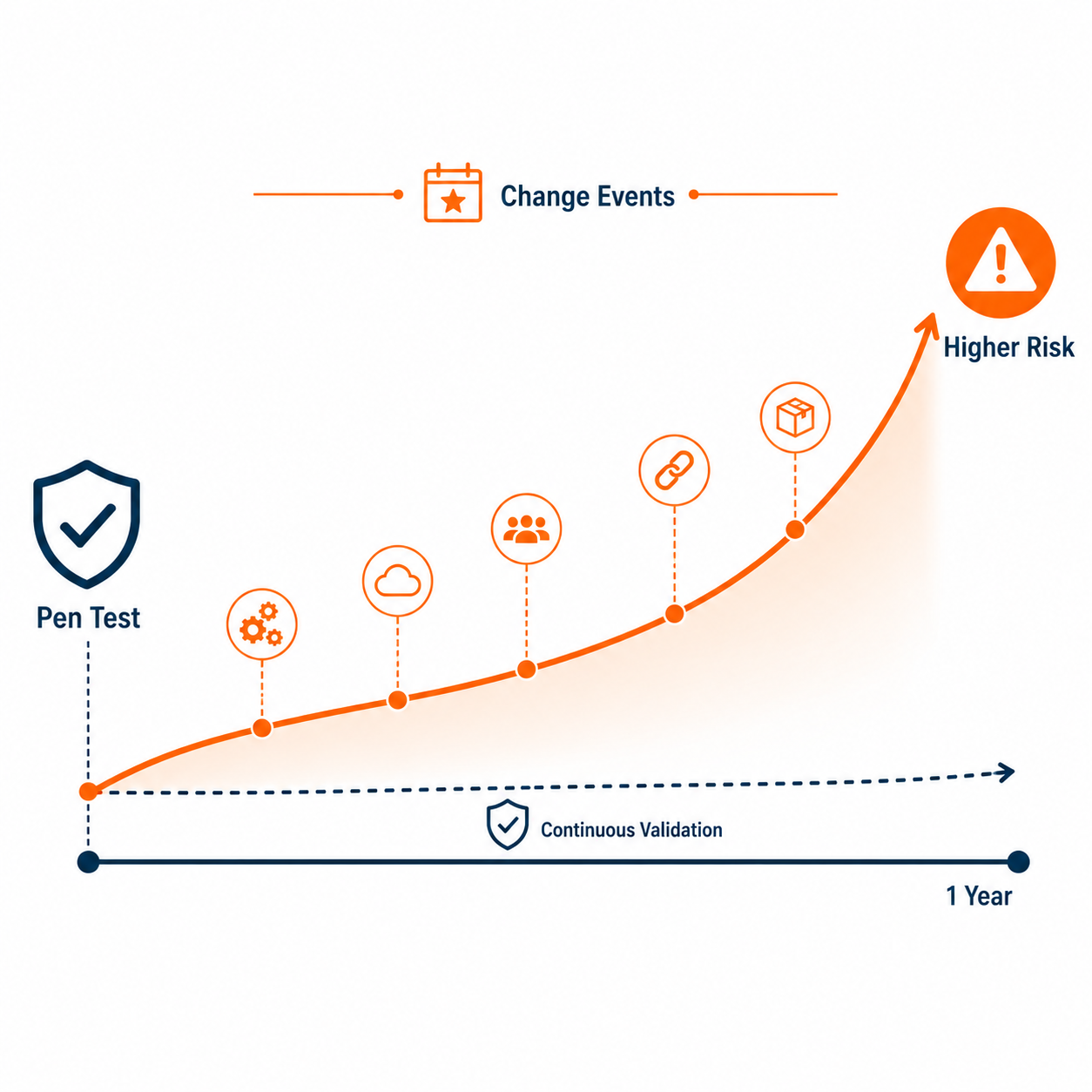
When a manufacturer runs a pen test in Q4 and receives the report in January, they have a snapshot of their security posture at a single point in time. By March, three new vendor remote access connections have been set up for equipment commissioning. By June, a new operational technology (OT) system has been connected to the historian, the database that archives process data. By September, a network reconfiguration has changed the segmentation between IT and OT. The next pen test is still three months away.
Every one of those changes is a potential new exposure that the last test did not see, and the next test has not yet found. Annual testing does not mean you are tested annually. It means you have a documented security posture once a year and an undocumented one for the other eleven months. Whether that is acceptable depends on how much your environment changes and how consequential a breach would be during the gap. The consequences can be severe: the August 2023 cyberattack on Clorox slowed production, caused significant product outages, and was blamed for most of a $356 million (20%) net sales decline the following quarter, on top of $49 million in direct response costs reported through December 2023.
What Compliance Frameworks Actually Require
Cybersecurity Maturity Model Certification (CMMC) Level 2 requires periodic assessments but does not prescribe a specific frequency beyond the triennial Certified Third-Party Assessment Organization (C3PAO) cycle. National Institute of Standards and Technology (NIST) 800-171 requires periodic testing of security controls without defining the interval. International Electrotechnical Commission (IEC) 62443 calls for security assessments aligned to risk but leaves cadence to the organization. None of these frameworks mandate annual testing. Most of them allow, and some implicitly encourage, more frequent testing for high-risk or high-change environments.
The compliance minimum is a floor, not a recommendation. Meeting the minimum keeps you compliant. It does not necessarily keep you secure, and regulators and frameworks are increasingly explicit about that distinction. An organization that tests annually and documents it is compliant. An organization that tests more frequently and can demonstrate a systematic approach to security validation is in a stronger position for both compliance purposes and actual risk management.
The Factors That Should Drive Your Cadence
Rate of change is the most important variable. A manufacturer running a stable, mature OT environment with minimal vendor access and infrequent network changes faces a different risk profile than one actively commissioning new equipment, integrating Industry 4.0 platforms or expanding remote access for operational efficiency. The higher the rate of change, the shorter the interval between tests needs to be to maintain meaningful visibility into the current security posture.
Previous findings and remediation completion rate matter as well. An organization that consistently closes findings between tests and maintains a low open finding count has demonstrated that its testing program is connected to its remediation process. An organization with a growing backlog of unaddressed findings from previous tests has a different problem than cadence and increasing testing frequency without fixing the remediation process will not help.
Trigger-Based Testing as a Complement to Scheduled Testing
The most mature manufacturing security programs combine a scheduled baseline test with trigger-based testing for specific changes. A new vendor remote access path gets tested when it is set up, not at the next scheduled test. A significant network reconfiguration gets validated before it goes into production. A new OT system gets assessed as part of its commissioning process.
This approach does not require a dramatically larger testing budget. It requires a testing partner with the flexibility to engage on shorter notice and a change management process that includes a security testing gate for high-risk changes. The payoff is a security posture that reflects the current environment rather than the environment as it existed at the last scheduled test date.
Building a Cadence That Works for Your Program
There is no universal right answer for pen test frequency in manufacturing. A single-site manufacturer with a stable OT environment and annual compliance requirements may be well-served by annual testing supplemented by trigger-based assessments for major changes. A multi-site manufacturer with active Industry 4.0 integration and CMMC obligations is almost certainly underserved by annual testing regardless of how well the test is executed.
The starting point is an honest assessment of your environment: how much it changes, what your current testing program is capturing and where the gaps between your last test and your current environment are largest. That assessment tells you what cadence makes sense for your specific situation, rather than what fits the budget cycle.
Your environment changed since your last test. Request a cadence assessment and find out whether your testing program still matches the way your plant operates.


Other Popular Articles
In the digital age, businesses must adopt an ad
GRC is the capability, or integrated collection
Get the latest insights straight from our desk to your inbox.
Other Featured Articles
Explore More
How Often Should Manufacturers Run OT Penetration Testing?
Annual pen testing fits a budget cycle but it doesn't reflect how fast manufacturing environments actually change.
Shantanoo Govilkar
SVP Strategic Solutions Risk & Cybersecurity Solutions view
Pharmaceutical Pen Testing: What 21 CFR Part 11 and cGMP Require
21 CFR Part 11 and cGMP don't mention penetration testing but the controls they require depend on it.
Shantanoo Govilkar
SVP Strategic Solutions Risk & Cybersecurity Solutions view
Pharmaceutical Pen Testing: Why R&D and GxP Need Different Scopes.
R&D and GxP regulated environments have different risk profiles, compliance requirements, and testing constraints.
Shantanoo Govilkar
SVP Strategic Solutions Risk & Cybersecurity Solutions view
Why Pharmaceutical Pen Testing Must Address Nation-State Threats
Nation-state actors treat pharma like critical infrastructure targeting formulation data, synthesis routes, and clinical IP with patience and precision.
Shantanoo Govilkar
SVP Strategic Solutions Risk & Cybersecurity Solutions view
How Ransomware Crosses the IT-OT Boundary (And How to Stop It)
Ransomware operators target the IT-OT boundary deliberately and they know manufacturing economics well.
Shantanoo Govilkar
SVP Strategic Solutions Risk & Cybersecurity Solutions view
Where Industry 4.0 Left Your OT Attack Surface Wide Open
Industry 4.0 connected OT environments were never built for. Learn why traditional IT security tools fall short and what OT penetration testing reveals that audits miss.
Shantanoo Govilkar
SVP Strategic Solutions Risk & Cybersecurity Solutions view
What AS4 Actually Solves: Real Outcomes Companies See After Migration
Discover what AS4 actually solves for modern businesses. Learn the real outcomes companies achieve after migration, from stronger security to better B2B integration performance.
EDI Solutions Group
Marketing Group view
7 Migration Pitfalls That Derail AS4 Upgrades (and How to Avoid Them)
Avoid costly AS4 upgrade mistakes. Discover 7 migration pitfalls that delay projects, create risk, and disrupt B2B messaging, plus practical ways to avoid them.
EDI Solutions Group
Marketing Group view
How to Perform Penetration Testing in Cloud Environments (AWS, Azure, and GCP) - 2026 Edition
A practical guide to cloud penetration testing across AWS, Azure, and GCP. Learn methods, tools, and best practices to identify vulnerabilities and improve security.
Cybersecurity Solutions Group
Marketing Group view
5 Signs It's Time to Move Legacy EDI Environment to AS4 Protocol
Partner onboarding delays, compliance gaps, and rising maintenance costs are signals your EDI infrastructure is reaching its limits. Learn the five signs it is time to evaluate a move to AS4.
EDI Solutions Group
Marketing Group view
How to Design Custom Chatbots That Cannot “Make Stuff Up”
Confident AI answers without traceable sources create institutional risk. Learn how Grounded RAG architecture retrieves real documents first and attaches verifiable citations to every response.
Data and AI Solutions Group
Marketing Group view
How Citation-Backed Conversational AI Improves Public Access and Internal Decision-Making
AI without source citations creates real liability. Learn how citation-backed AI brings traceable sources, version awareness, and audit-ready outputs to every institutional decision.
Data and AI Solutions Group
Marketing Group view
How to Perform a Successful Network Penetration Test: Comprehensive Guide for 2025
Learn how to perform a successful network penetration test to identify vulnerabilities, simulate real cyberattacks, and strengthen your organization’s network security.
Cybersecurity Solutions Group
Marketing Group view
What Is Penetration Testing? A 2026 Expert Guide
A 2026 expert guide to penetration testing for security leaders and IT teams seeking proactive defense, compliance, and stakeholder trust.
Cybersecurity Solutions Group
Marketing Group view
OT Ransomware Prevention: Practical Best Practices for Industrial Cybersecurity
Explore enterprise grade OT ransomware prevention strategies, including segmentation, identity control, threat informed detection, and resilient recovery design to protect industrial operations fro
Cybersecurity Solutions Group
Marketing Group view
10 Myths About OT/ICS Security That Put Your Business at Risk
Think your OT network is secure? Learn the 10 most dangerous myths about OT and ICS cybersecurity that leave industrial operations exposed to attacks.
Cybersecurity Solutions Group
Marketing Group view
OT Ransomware Risks and Response for Industrial Systems
Learn why OT environments face higher ransomware risk, how attackers gain access, and how effective detection and response reduce operational impact.
Cybersecurity Solutions Group
Marketing Group view
AI Risk Assessment: Risk Types, Best Practices & More
Explore AI risk types, essential assessment frameworks, and proven best practices to mitigate threats in AI deployment. Learn actionable strategies for secure AI systems today.
Cybersecurity Solutions Group
Marketing Group view
AI Risk Assessment: Everything You Need to Know
Learn essential processes, methodologies, risk types, regulatory requirements, and practical implementation strategies for safe AI deployment.
Cybersecurity Solutions Group
Marketing Group view
Whitepaper: Ransomware Threat Management
Ransomware continues to be a real threat to business operations across all industries, no organization is safe from this threat.
Laszlo S. Gonc
CISSP, First Senior Fellow, DivIHN Cybersecurity Center of Excellence view
Cybersecurity Incident Response Preparedness
An incident response framework provides a structure to support incident response operations. A framework typically provides guidance on what needs to be done, but not on how it is done.
Laszlo S. Gonc
CISSP, First Senior Fellow, DivIHN Cybersecurity Center of Excellence view
IoT Medical Device Cybersecurity
Healthcare data and medical devices would be aggressively targeted by ransomware attacks since early 2017 has proven to be true