
Map Your OT Attack Surface Before the Next Audit
Contributors


Most operational technology (OT) security audits produce findings that surprise the teams being audited. Not because the auditors are unusually thorough, but because the organizations being audited do not have a current picture of their own environment. An attack surface map fixes that. It gives you visibility into what you actually have before someone else tells you what you missed. The someone else is not always an auditor: Censys counts over 145,000 exposed industrial control system (ICS) services worldwide, more than 48,000 of them in the United States.
What an Attack Surface Map Actually Is
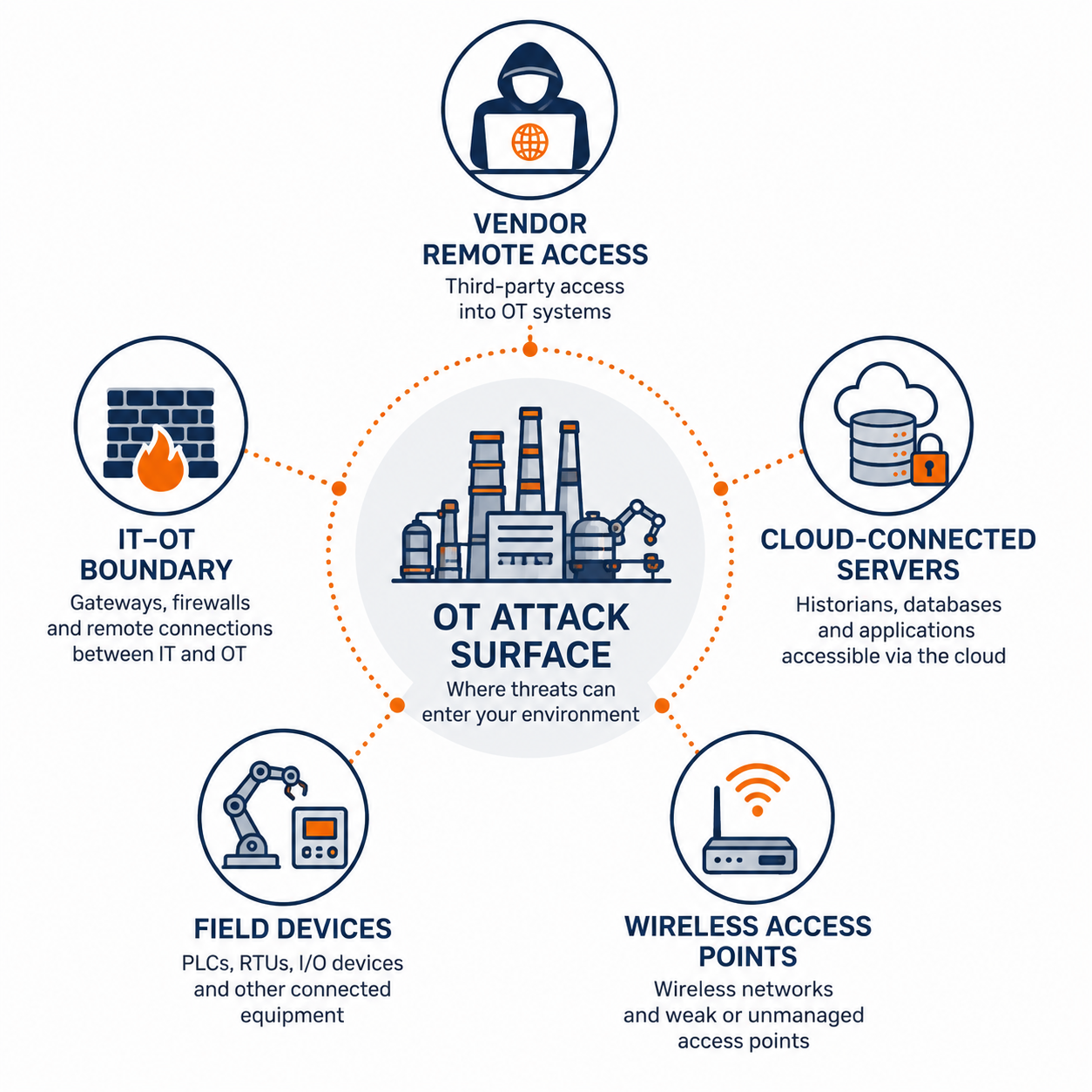
An OT attack surface map is a documented, current picture of every way an attacker could reach your operational technology environment. That includes every device on the network, every remote access path, every point where IT and OT traffic can cross and every external connection to vendors, cloud platforms or partner systems. It is not the same as a network diagram, which typically shows intended architecture. An attack surface map shows reality, including the things that were added for convenience and never formally reviewed. Those unreviewed paths carry real cost. In May 2021, attackers reached Colonial Pipeline through a legacy virtual private network (VPN) profile that was not intended to be in use. The company shut down fuel delivery for the East Coast and paid a $4.4 million ransom.
Auditors build a version of this picture during their assessment. The difference is that they build it looking for problems, and they share what they find in a report you receive after the audit is complete. Building your own map before the audit means you find those problems first, on your own timeline, with time to address them.
How to Build the Inventory You Actually Need
Passive discovery is the right starting point for OT environments. Monitoring network traffic at span ports or taps reveals what is actually communicating on the network, which is often different from what the documentation says. Devices that were installed temporarily and never removed. Legacy systems that were supposed to be decommissioned. Wireless access points that the OT vendor installed during commissioning and that nobody in the security team knows about.
The goal is not a perfect inventory built in a single effort. It is a living document that reflects the current state of the environment. For most manufacturers, getting to that state requires combining passive discovery with interviews with the operations team, review of vendor contracts and access agreements, and a physical walkthrough of the plant floor.
Mapping Topology and Exposure
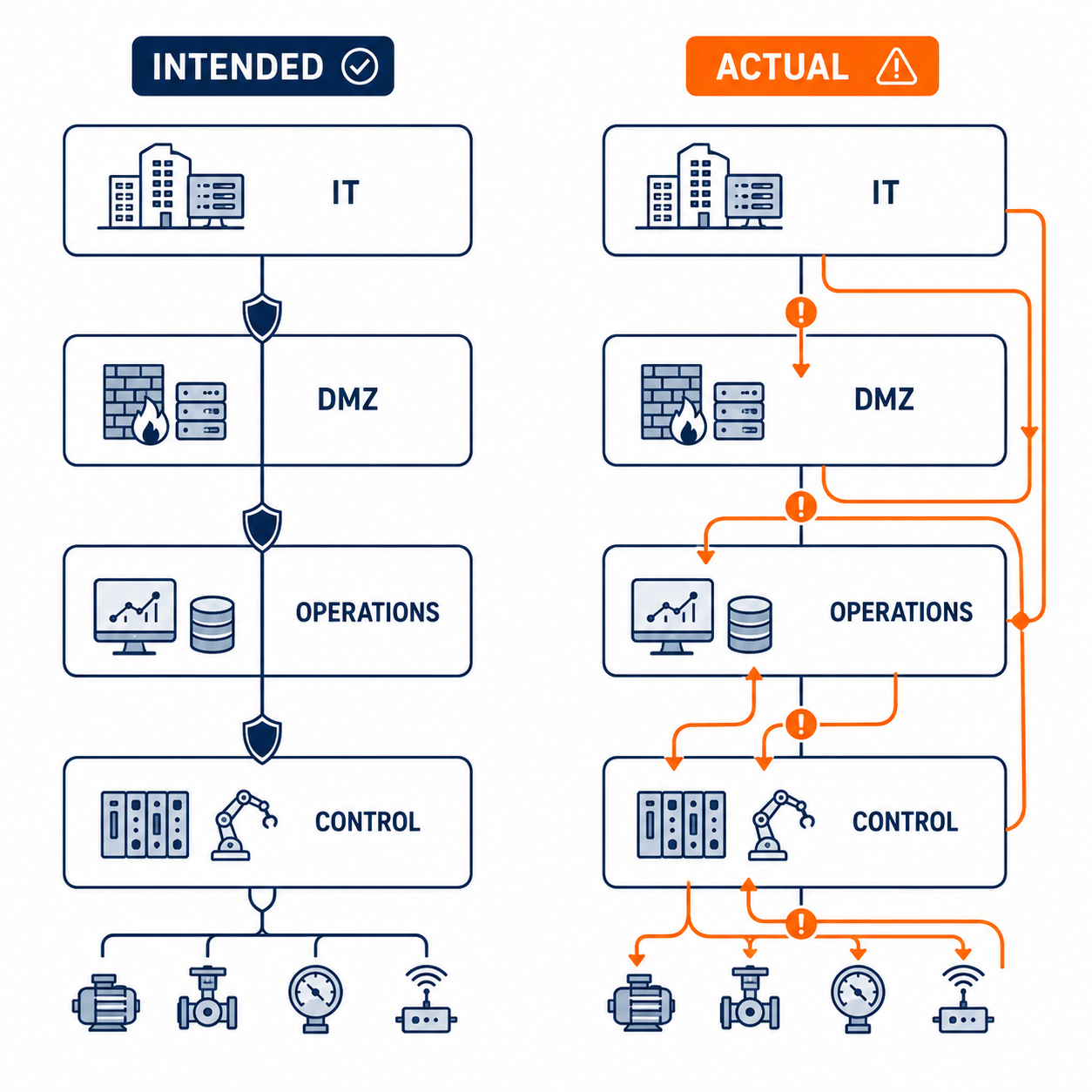
Once you have the asset inventory, the next step is understanding how those assets connect to each other and to the outside world. Zone and conduit mapping based on IEC 62443 is the right framework for this. It identifies where traffic should be allowed to flow, where it should be blocked and where the current state deviates from the intended architecture.
The most common finding at this stage is a network that is segmented on paper but flat in practice. Virtual local area networks (VLANs) that were configured without enforcing communication restrictions. Firewall rules that allow broad traffic between IT and OT zones because they were set up during a project deadline and never tightened. A demilitarized zone (DMZ) that exists in the architecture diagram but is not actually enforced in the network configuration. The pattern is widespread: Dragos found improper network segmentation in 50% of its 2022 service engagements.
Prioritizing What You Find
Not every exposure in your attack surface carries the same risk. A vendor remote access path with default credentials that connects directly to a distributed control system (DCS) controller is a different category of problem from an unpatched human-machine interface (HMI) that can only be reached from inside the plant network. Prioritization has to reflect both the likelihood of exploitation and the consequence if an attacker gets there.
For manufacturers under compliance requirements, whether NIST, IEC 62443 or sector-specific frameworks, the prioritization also needs to map to the controls those frameworks require. Auditors are not just looking for vulnerabilities. They are looking for evidence that you understand your exposure and are managing it systematically.
A risk-based attack surface assessment gives you both things. It identifies what is exposed, ranks it by real-world risk and maps it to the compliance requirements your auditors will check. That is a much stronger position to be in than receiving those findings in an audit report for the first time.
An audit will map your attack surface eventually, on the auditor’s timeline. Map it first. Request an OT attack surface assessment and walk into the next audit with the findings already in hand.

Frequently Asked Questions
An OT attack surface map is a documented, current picture of every way an attacker could reach your operational technology environment. It includes every device on the network, every remote access path, every point where IT and OT traffic can cross, and every external connection to vendors, cloud platforms, or partner systems. Unlike a network diagram, which shows intended architecture, an attack surface map shows reality, including paths added for convenience and never formally reviewed.
A network diagram shows intended architecture, meaning how the environment was designed to work. An attack surface map shows the actual state, including the connections, devices, and access paths that were added over time and never documented. This difference matters because attackers exploit reality, not the diagram. Colonial Pipeline was breached in May 2021 through a legacy VPN profile that was not meant to be in use, which a current attack surface map would have flagged.
Because an auditor will map it eventually, on their timeline, and share the findings in a report only after the assessment is complete. Building your own map first means you find the problems on your own schedule, with time to fix them before they become audit findings. It also demonstrates to auditors that you understand and actively manage your exposure, which is what compliance frameworks are designed to verify.
Passive discovery means monitoring network traffic at span ports or taps to reveal what is actually communicating on the network, without sending any traffic to live devices. It is the right starting point for OT because it carries zero risk to production while surfacing what documentation misses: temporary devices never removed, systems that were supposed to be decommissioned, and wireless access points an OT vendor installed during commissioning that the security team never knew about.
Treat the inventory as a living document that reflects the current state, not a one-time project. For most manufacturers, reaching that state means combining passive discovery with interviews with the operations team, a review of vendor contracts and access agreements, and a physical walkthrough of the plant floor. The goal is not a perfect inventory built in a single effort, but one that is kept current as the environment changes.
Zone and conduit mapping based on IEC 62443 is the right framework. It identifies where traffic should be allowed to flow, where it should be blocked, and where the current state deviates from the intended architecture. Applying it turns a raw asset inventory into a picture of how assets connect to each other and to the outside world, which is where most real exposure lives.
It describes an OT network that looks segmented in the architecture diagram but does not enforce those boundaries in practice. Common examples include VLANs configured without communication restrictions, firewall rules that allow broad IT-to-OT traffic because they were set during a deadline and never tightened, and a DMZ that exists in the diagram but is not enforced in the actual configuration. Dragos found improper network segmentation in 50% of its 2022 service engagements.
Prioritization must reflect both the likelihood of exploitation and the consequence if an attacker succeeds. A vendor remote access path with default credentials connecting directly to a DCS controller is a far higher priority than an unpatched HMI reachable only from inside the plant network. For organizations under compliance obligations, the ranking should also map to the specific controls that NIST, IEC 62443, or sector frameworks require.
Exposure is widespread. Censys counts more than 145,000 exposed industrial control system services worldwide, with over 48,000 of them in the United States alone. This is why mapping matters: many organizations have internet-reachable OT assets they are not fully aware of, and those assets are visible to attackers scanning for them long before any audit takes place.
It showed how a single unreviewed access path can cause major operational impact. In May 2021, attackers reached Colonial Pipeline through a legacy VPN profile that was not intended to be in use. The company shut down fuel delivery for the East Coast and paid a $4.4 million ransom. A current attack surface map is designed to surface exactly this kind of forgotten path before an attacker finds it.



Other Popular Articles
In the digital age, businesses must adopt an ad
GRC is the capability, or integrated collection
Get the latest insights straight from our desk to your inbox.
Other Featured Articles
Explore More
What Is CMMC and Do You Need It?
Learn what CMMC is, who needs it, and how to determine if your business requires Level 1 compliance for DoD contracts.
Shantanoo Govilkar
SVP Strategic Solutions Risk & Cybersecurity Solutions view
CMMC Level 1 vs Level 2, Which Applies to You?
Learn the key differences between CMMC Level 1 and Level 2, understand FCI vs. CUI, and determine which CMMC level your DoD contract requires to avoid unnecessary costs or compliance risks.
Shantanoo Govilkar
SVP Strategic Solutions Risk & Cybersecurity Solutions view
What CMMC Means for DoD Subcontractors
Understand what CMMC means for DoD subcontractors, how compliance requirements flow down from prime contractors, who must comply, and the steps to determine your CMMC obligations.
Shantanoo Govilkar
SVP Strategic Solutions Risk & Cybersecurity Solutions view
How to Complete Your CMMC Level 1 Self Assessment
Complete CMMC Level 1 self-assessment guide: define scope, work through 15 practices, fix common gaps, and submit your SPRS affirmation.
Shantanoo Govilkar
SVP Strategic Solutions Risk & Cybersecurity Solutions view
The October 2026 CMMC Deadline: What Happens If You Miss It
Prepare for the October 2026 CMMC deadline. Learn how compliance affects DoD contract eligibility, SPRS affirmations, renewals, and subcontractors.
Shantanoo Govilkar
SVP Strategic Solutions Risk & Cybersecurity Solutions view
Operational Technology (OT) Penetration Testing Guide for Ransomware Defense
Ransomware doesn't need to breach your control room it needs to get close enough that you can't trust it hasn't.
Shantanoo Govilkar
SVP Strategic Solutions Risk & Cybersecurity Solutions view
A Medical Device Maker's Guide to FDA Cybersecurity Testing for 510(k) & PMA
The FDA doesn't publish a pen testing checklist, but its guidance, 524B requirements, and reviewer expectations add up to one.
Shantanoo Govilkar
SVP Strategic Solutions Risk & Cybersecurity Solutions view
Pharma Pen Testing: Why FDA and IP Risk Need Different Scoping
Standard pen test scoping frameworks weren't built for pharma.
Shantanoo Govilkar
SVP Strategic Solutions Risk & Cybersecurity Solutions view
FDA 524B Is Here: What Medical Device Makers Must Test Now
Section 524B made medical device cybersecurity a legal requirement, not a guideline.
Shantanoo Govilkar
SVP Strategic Solutions Risk & Cybersecurity Solutions view
Why CHIPS Act Manufacturers Can't Rely on CMMC Pen Testing Alone
Semiconductor manufacturers face dual compliance obligations under CMMC 2.0 and the CHIPS Act and a standard pen test satisfies neither fully.
Shantanoo Govilkar
SVP Strategic Solutions Risk & Cybersecurity Solutions view
Why Pen Test Evidence Fails C3PAO Assessments (and How to Fix It)
Completing a pen test isn't enough for CMMC.
Shantanoo Govilkar
SVP Strategic Solutions Risk & Cybersecurity Solutions view
PTaaS vs. Annual Pen Testing: Why Manufacturers Are Switching
Annual penetration testing produces documentation, not security.
Shantanoo Govilkar
SVP Strategic Solutions Risk & Cybersecurity Solutions view
Map Your OT Attack Surface Before the Next Audit
Don't wait for an auditor to tell you what you missed.
Shantanoo Govilkar
SVP Strategic Solutions Risk & Cybersecurity Solutions view
How to Scope IT-OT Penetration Testing Safely
Learn how to safely scope IT-OT penetration testing engagements.
Shantanoo Govilkar
SVP Strategic Solutions Risk & Cybersecurity Solutions view
How Often Should Manufacturers Run OT Penetration Testing?
Annual pen testing fits a budget cycle but it doesn't reflect how fast manufacturing environments actually change.
Shantanoo Govilkar
SVP Strategic Solutions Risk & Cybersecurity Solutions view
Pharmaceutical Pen Testing: What 21 CFR Part 11 and cGMP Require
21 CFR Part 11 and cGMP don't mention penetration testing but the controls they require depend on it.
Shantanoo Govilkar
SVP Strategic Solutions Risk & Cybersecurity Solutions view
Pharmaceutical Pen Testing: Why R&D and GxP Need Different Scopes
R&D and GxP regulated environments have different risk profiles, compliance requirements, and testing constraints.
Shantanoo Govilkar
SVP Strategic Solutions Risk & Cybersecurity Solutions view
Why Pharmaceutical Pen Testing Must Address Nation-State Threats
Nation-state actors treat pharma like critical infrastructure targeting formulation data, synthesis routes, and clinical IP with patience and precision.
Shantanoo Govilkar
SVP Strategic Solutions Risk & Cybersecurity Solutions view
How Ransomware Crosses the IT-OT Boundary (And How to Stop It)
Ransomware operators target the IT-OT boundary deliberately and they know manufacturing economics well.
Shantanoo Govilkar
SVP Strategic Solutions Risk & Cybersecurity Solutions view
Where Industry 4.0 Left Your OT Attack Surface Wide Open
Industry 4.0 connected OT environments were never built for. Learn why traditional IT security tools fall short and what OT penetration testing reveals that audits miss.
Shantanoo Govilkar
SVP Strategic Solutions Risk & Cybersecurity Solutions view
What AS4 Actually Solves: Real Outcomes Companies See After Migration
Discover what AS4 actually solves for modern businesses. Learn the real outcomes companies achieve after migration, from stronger security to better B2B integration performance.
EDI Solutions Group
Marketing Group view
7 Migration Pitfalls That Derail AS4 Upgrades (and How to Avoid Them)
Avoid costly AS4 upgrade mistakes. Discover 7 migration pitfalls that delay projects, create risk, and disrupt B2B messaging, plus practical ways to avoid them.
EDI Solutions Group
Marketing Group view
How to Perform Penetration Testing in Cloud Environments (AWS, Azure, and GCP) - 2026 Edition
A practical guide to cloud penetration testing across AWS, Azure, and GCP. Learn methods, tools, and best practices to identify vulnerabilities and improve security.
Cybersecurity Solutions Group
Marketing Group view
5 Signs It's Time to Move Legacy EDI Environment to AS4 Protocol
Partner onboarding delays, compliance gaps, and rising maintenance costs are signals your EDI infrastructure is reaching its limits. Learn the five signs it is time to evaluate a move to AS4.
EDI Solutions Group
Marketing Group view
How to Design Custom Chatbots That Cannot “Make Stuff Up”
Confident AI answers without traceable sources create institutional risk. Learn how Grounded RAG architecture retrieves real documents first and attaches verifiable citations to every response.
Data and AI Solutions Group
Marketing Group view
How Citation-Backed Conversational AI Improves Public Access and Internal Decision-Making
AI without source citations creates real liability. Learn how citation-backed AI brings traceable sources, version awareness, and audit-ready outputs to every institutional decision.
Data and AI Solutions Group
Marketing Group view
How to Perform a Successful Network Penetration Test: Comprehensive Guide for 2025
Learn how to perform a successful network penetration test to identify vulnerabilities, simulate real cyberattacks, and strengthen your organization’s network security.
Cybersecurity Solutions Group
Marketing Group view
What Is Penetration Testing? A 2026 Expert Guide
A 2026 expert guide to penetration testing for security leaders and IT teams seeking proactive defense, compliance, and stakeholder trust.
Cybersecurity Solutions Group
Marketing Group view
OT Ransomware Prevention: Practical Best Practices for Industrial Cybersecurity
Explore enterprise grade OT ransomware prevention strategies, including segmentation, identity control, threat informed detection, and resilient recovery design to protect industrial operations fro
Cybersecurity Solutions Group
Marketing Group view
10 Myths About OT/ICS Security That Put Your Business at Risk
Think your OT network is secure? Learn the 10 most dangerous myths about OT and ICS cybersecurity that leave industrial operations exposed to attacks.
Cybersecurity Solutions Group
Marketing Group view
OT Ransomware Risks and Response for Industrial Systems
Learn why OT environments face higher ransomware risk, how attackers gain access, and how effective detection and response reduce operational impact.
Cybersecurity Solutions Group
Marketing Group view
AI Risk Assessment: Risk Types, Best Practices & More
Explore AI risk types, essential assessment frameworks, and proven best practices to mitigate threats in AI deployment. Learn actionable strategies for secure AI systems today.
Cybersecurity Solutions Group
Marketing Group view
AI Risk Assessment: Everything You Need to Know
Learn essential processes, methodologies, risk types, regulatory requirements, and practical implementation strategies for safe AI deployment.
Cybersecurity Solutions Group
Marketing Group view
Whitepaper: Ransomware Threat Management
Ransomware continues to be a real threat to business operations across all industries, no organization is safe from this threat.
Laszlo S. Gonc
CISSP, First Senior Fellow, DivIHN Cybersecurity Center of Excellence view
Cybersecurity Incident Response Preparedness
An incident response framework provides a structure to support incident response operations. A framework typically provides guidance on what needs to be done, but not on how it is done.
Laszlo S. Gonc
CISSP, First Senior Fellow, DivIHN Cybersecurity Center of Excellence view
IoT Medical Device Cybersecurity
Healthcare data and medical devices would be aggressively targeted by ransomware attacks since early 2017 has proven to be true