
Why CHIPS Act Manufacturers Can't Rely onCMMC Pen Testing Alone
Contributors


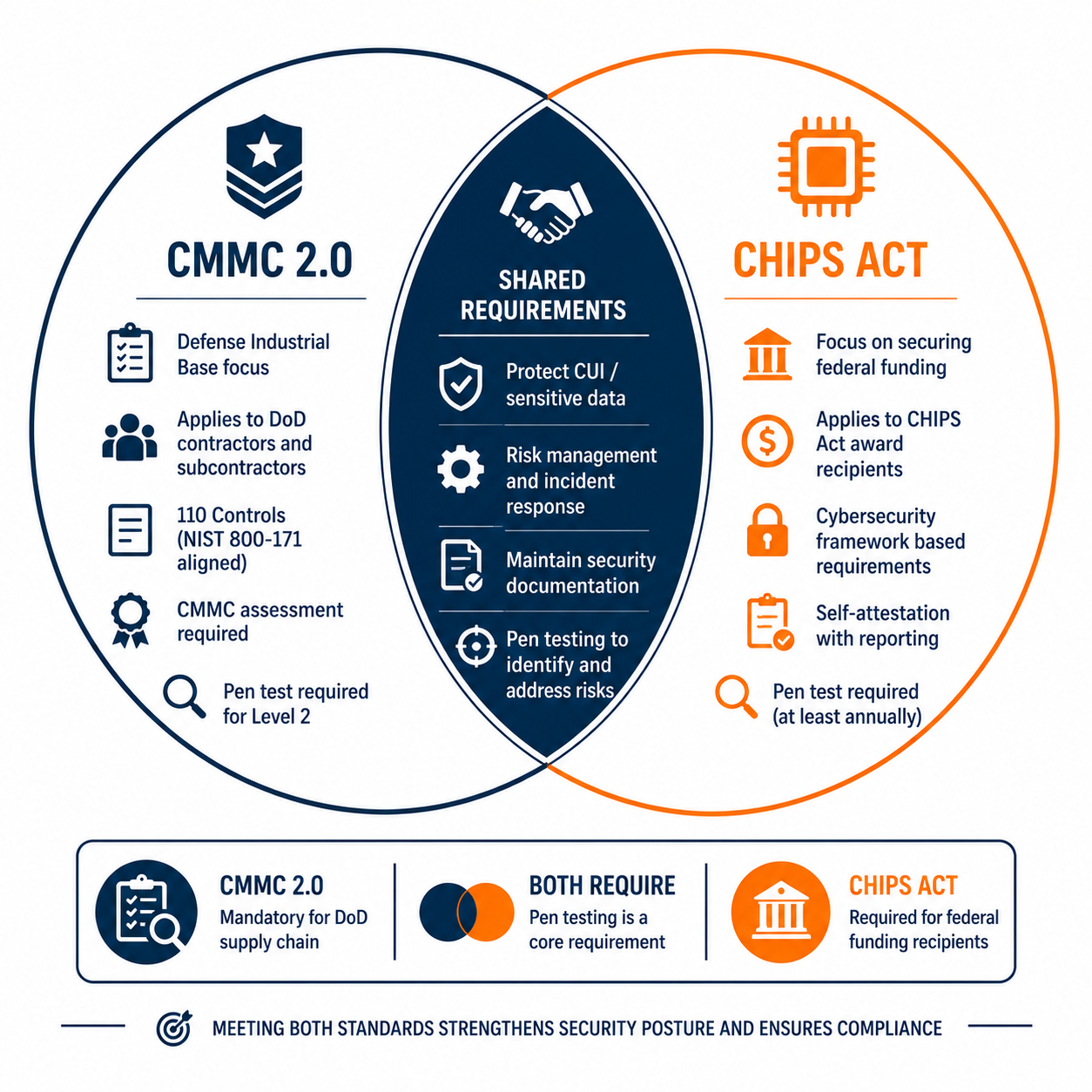
Semiconductor manufacturers pursuing CHIPS Act funding face a compliance environment that most cybersecurity frameworks were not designed to handle simultaneously. CMMC 2.0 governs their obligations as defense supply chain participants. CHIPS Act cybersecurity conditions govern their obligations as recipients of federal manufacturing investment. These are not the same requirements, and the overlap between them is not as clean as either framework document suggests.
How the Two Frameworks Create a Dual Obligation
CMMC 2.0 is a supply chain security framework. Its requirements flow from the DoD's need to protect controlled unclassified information across the defense industrial base. For a semiconductor manufacturer supplying components or designs to defense programs, CMMC Level 2 or Level 3 requirements apply to the systems that handle that CUI.
CHIPS Act cybersecurity conditions are tied to funding eligibility and ongoing compliance for facilities receiving grants or loans under the program. They focus on protecting the advanced manufacturing capabilities and intellectual property that the federal investment is funding. The threat model is different: less about protecting DoD information and more about protecting domestic semiconductor technology from foreign adversaries.
What Your Pen Test Must Cover for Each Framework
For CMMC purposes, the pen test scope centers on CUI systems: the networks, workstations, servers and applications that process, store or transmit controlled unclassified information. The methodology and evidence requirements follow the standard C3PAO framework: NIST 800-171 control mapping, SSP alignment and POA&M integration.
For CHIPS Act purposes, the scope expands to include systems that protect advanced manufacturing IP, process design files and fabrication technology. Fab OT systems, which may be largely excluded from a standard CMMC scope because they do not handle CUI directly, become relevant when the question is whether federal investment in those systems is adequately protected from nation-state actors. Supply chain interfaces with equipment vendors and technology partners are also in scope in ways that CMMC does not require.
Where the Evidence Requirements Diverge
CMMC evidence requirements are well-defined. C3PAO assessors know what they are looking for and how it maps to the 110 practices they evaluate. CHIPS Act federal program officers reviewing cybersecurity compliance are evaluating against a different standard, and the documentation they expect reflects a broader set of concerns about technology protection and supply chain security.
Running a single pen test engagement that produces two separate evidence packages, one structured for C3PAO review and one structured for CHIPS Act program officer review, is achievable but requires deliberate planning before the engagement starts. The scope must be broad enough to cover both sets of requirements. The reporting must be structured to address both audiences without requiring the pen test team to run two separate engagements.
Common Gaps in Semiconductor Pen Test Programs
The most common gap in semiconductor manufacturer pen test programs is fab OT exclusion. Engineering teams are understandably protective of cleanroom and process control systems, and standard OT scoping practices lead to those systems being excluded from scope entirely. That exclusion satisfies CMMC requirements, which do not mandate testing of non-CUI OT systems. It does not satisfy CHIPS Act expectations around protecting the manufacturing technology the federal investment is funding.
Supply chain interface testing is the second most common gap. Semiconductor manufacturers have complex vendor ecosystems involving equipment manufacturers, EDA tool providers and research partners. The access those relationships require is a significant attack surface that is rarely tested because it falls outside the boundaries of a standard enterprise pen test scope.
Building a Program That Satisfies Both
The most efficient path to dual compliance is a unified pen test program with a scope built from both frameworks simultaneously, not two separate programs run independently. That requires a security partner who understands both CMMC assessment requirements and the threat model that CHIPS Act cybersecurity conditions are designed to address.

Frequently Asked Questions
Because CMMC and the CHIPS Act impose two different obligations with two different threat models, and a pen test scoped for one does not satisfy the other. CMMC 2.0 governs a manufacturer's duties as a defense supply chain participant handling controlled unclassified information. CHIPS Act cybersecurity conditions govern its duties as a recipient of federal manufacturing investment. A standard CMMC-scoped test leaves the manufacturing technology that CHIPS funding protects largely untested.
CMMC 2.0 is a supply chain security framework whose requirements flow from the Department of Defense's need to protect controlled unclassified information across the defense industrial base. CHIPS Act cybersecurity conditions are tied to funding eligibility and focus on protecting the advanced manufacturing capabilities and intellectual property that the federal investment is funding. The threat models differ: CMMC is about protecting DoD information, while the CHIPS Act is about protecting domestic semiconductor technology from foreign adversaries.
For CMMC purposes, the pen test scope centers on CUI systems: the networks, workstations, servers, and applications that process, store, or transmit controlled unclassified information. The methodology and evidence follow the standard C3PAO framework, including NIST 800-171 control mapping, system security plan alignment, and POA&M integration across the 110 practices that assessors evaluate at Level 2.
For CHIPS Act purposes, the scope expands beyond CUI systems to include the systems that protect advanced manufacturing intellectual property, process design files, and fabrication technology. Fab OT systems become relevant even when they do not handle CUI directly, because the question is whether federal investment in those systems is adequately protected from nation-state actors. Supply chain interfaces with equipment vendors and technology partners are also in scope in ways CMMC does not require.
Fab OT systems get excluded because engineering teams are protective of cleanroom and process control systems, and standard OT scoping practices leave non-CUI systems out of scope. That exclusion satisfies CMMC, which does not mandate testing of non-CUI OT systems. It does not satisfy CHIPS Act expectations, because those systems hold the manufacturing technology the federal investment is funding, making their exclusion the most common gap in semiconductor pen test programs.
Because semiconductor manufacturers have complex vendor ecosystems, and the access those relationships require is a significant, rarely tested attack surface. The ecosystem includes equipment manufacturers, EDA tool providers, and research partners, each with connections into sensitive systems. This interface testing is the second most common gap in semiconductor pen test programs, because it falls outside the boundaries of a standard enterprise pen test scope.
Yes, but only with deliberate planning before the engagement begins. A single engagement can produce two separate evidence packages, one structured for C3PAO review and one structured for CHIPS Act program officer review, without running two independent tests. The scope has to be broad enough to cover both sets of requirements, and the reporting has to be structured to address both audiences from the start rather than being reworked afterward.
Because the two reviewers are evaluating against different standards. C3PAO assessors know exactly what they are looking for and how it maps to the 110 CMMC practices. CHIPS Act federal program officers evaluate against a broader set of concerns about technology protection and supply chain security, so the documentation they expect reflects those priorities. The same test can inform both, but the evidence has to be packaged differently for each audience.
The two most common gaps are fab OT exclusion and untested supply chain interfaces. Fab OT systems are left out because they do not handle CUI, which satisfies CMMC but not the CHIPS Act. Supply chain interfaces with equipment makers, EDA tool providers, and research partners are rarely tested because they sit outside a standard enterprise scope. Both gaps leave the manufacturing technology that federal investment funds exposed.
Build a single unified program with a scope drawn from both frameworks at the same time, rather than running two separate programs. This is the most efficient path to dual compliance, and it depends on a security partner who understands both CMMC assessment requirements and the nation-state threat model the CHIPS Act conditions are designed to address. Planning the combined scope before testing begins is what makes one engagement serve both obligations.



Other Popular Articles
In the digital age, businesses must adopt an ad
GRC is the capability, or integrated collection
Get the latest insights straight from our desk to your inbox.
Other Featured Articles
Explore More
What Is CMMC and Do You Need It?
Learn what CMMC is, who needs it, and how to determine if your business requires Level 1 compliance for DoD contracts.
Shantanoo Govilkar
SVP Strategic Solutions Risk & Cybersecurity Solutions view
CMMC Level 1 vs Level 2, Which Applies to You?
Learn the key differences between CMMC Level 1 and Level 2, understand FCI vs. CUI, and determine which CMMC level your DoD contract requires to avoid unnecessary costs or compliance risks.
Shantanoo Govilkar
SVP Strategic Solutions Risk & Cybersecurity Solutions view
What CMMC Means for DoD Subcontractors
Understand what CMMC means for DoD subcontractors, how compliance requirements flow down from prime contractors, who must comply, and the steps to determine your CMMC obligations.
Shantanoo Govilkar
SVP Strategic Solutions Risk & Cybersecurity Solutions view
How to Complete Your CMMC Level 1 Self Assessment
Complete CMMC Level 1 self-assessment guide: define scope, work through 15 practices, fix common gaps, and submit your SPRS affirmation.
Shantanoo Govilkar
SVP Strategic Solutions Risk & Cybersecurity Solutions view
The October 2026 CMMC Deadline: What Happens If You Miss It
Prepare for the October 2026 CMMC deadline. Learn how compliance affects DoD contract eligibility, SPRS affirmations, renewals, and subcontractors.
Shantanoo Govilkar
SVP Strategic Solutions Risk & Cybersecurity Solutions view
Operational Technology (OT) Penetration Testing Guide for Ransomware Defense
Ransomware doesn't need to breach your control room it needs to get close enough that you can't trust it hasn't.
Shantanoo Govilkar
SVP Strategic Solutions Risk & Cybersecurity Solutions view
A Medical Device Maker's Guide to FDA Cybersecurity Testing for 510(k) & PMA
The FDA doesn't publish a pen testing checklist, but its guidance, 524B requirements, and reviewer expectations add up to one.
Shantanoo Govilkar
SVP Strategic Solutions Risk & Cybersecurity Solutions view
Pharma Pen Testing: Why FDA and IP Risk Need Different Scoping
Standard pen test scoping frameworks weren't built for pharma.
Shantanoo Govilkar
SVP Strategic Solutions Risk & Cybersecurity Solutions view
FDA 524B Is Here: What Medical Device Makers Must Test Now
Section 524B made medical device cybersecurity a legal requirement, not a guideline.
Shantanoo Govilkar
SVP Strategic Solutions Risk & Cybersecurity Solutions view
Why CHIPS Act Manufacturers Can't Rely on CMMC Pen Testing Alone
Semiconductor manufacturers face dual compliance obligations under CMMC 2.0 and the CHIPS Act and a standard pen test satisfies neither fully.
Shantanoo Govilkar
SVP Strategic Solutions Risk & Cybersecurity Solutions view
Why Pen Test Evidence Fails C3PAO Assessments (and How to Fix It)
Completing a pen test isn't enough for CMMC.
Shantanoo Govilkar
SVP Strategic Solutions Risk & Cybersecurity Solutions view
PTaaS vs. Annual Pen Testing: Why Manufacturers Are Switching
Annual penetration testing produces documentation, not security.
Shantanoo Govilkar
SVP Strategic Solutions Risk & Cybersecurity Solutions view
Map Your OT Attack Surface Before the Next Audit
Don't wait for an auditor to tell you what you missed.
Shantanoo Govilkar
SVP Strategic Solutions Risk & Cybersecurity Solutions view
How to Scope IT-OT Penetration Testing Safely
Learn how to safely scope IT-OT penetration testing engagements.
Shantanoo Govilkar
SVP Strategic Solutions Risk & Cybersecurity Solutions view
How Often Should Manufacturers Run OT Penetration Testing?
Annual pen testing fits a budget cycle but it doesn't reflect how fast manufacturing environments actually change.
Shantanoo Govilkar
SVP Strategic Solutions Risk & Cybersecurity Solutions view
Pharmaceutical Pen Testing: What 21 CFR Part 11 and cGMP Require
21 CFR Part 11 and cGMP don't mention penetration testing but the controls they require depend on it.
Shantanoo Govilkar
SVP Strategic Solutions Risk & Cybersecurity Solutions view
Pharmaceutical Pen Testing: Why R&D and GxP Need Different Scopes
R&D and GxP regulated environments have different risk profiles, compliance requirements, and testing constraints.
Shantanoo Govilkar
SVP Strategic Solutions Risk & Cybersecurity Solutions view
Why Pharmaceutical Pen Testing Must Address Nation-State Threats
Nation-state actors treat pharma like critical infrastructure targeting formulation data, synthesis routes, and clinical IP with patience and precision.
Shantanoo Govilkar
SVP Strategic Solutions Risk & Cybersecurity Solutions view
How Ransomware Crosses the IT-OT Boundary (And How to Stop It)
Ransomware operators target the IT-OT boundary deliberately and they know manufacturing economics well.
Shantanoo Govilkar
SVP Strategic Solutions Risk & Cybersecurity Solutions view
Where Industry 4.0 Left Your OT Attack Surface Wide Open
Industry 4.0 connected OT environments were never built for. Learn why traditional IT security tools fall short and what OT penetration testing reveals that audits miss.
Shantanoo Govilkar
SVP Strategic Solutions Risk & Cybersecurity Solutions view
What AS4 Actually Solves: Real Outcomes Companies See After Migration
Discover what AS4 actually solves for modern businesses. Learn the real outcomes companies achieve after migration, from stronger security to better B2B integration performance.
EDI Solutions Group
Marketing Group view
7 Migration Pitfalls That Derail AS4 Upgrades (and How to Avoid Them)
Avoid costly AS4 upgrade mistakes. Discover 7 migration pitfalls that delay projects, create risk, and disrupt B2B messaging, plus practical ways to avoid them.
EDI Solutions Group
Marketing Group view
How to Perform Penetration Testing in Cloud Environments (AWS, Azure, and GCP) - 2026 Edition
A practical guide to cloud penetration testing across AWS, Azure, and GCP. Learn methods, tools, and best practices to identify vulnerabilities and improve security.
Cybersecurity Solutions Group
Marketing Group view
5 Signs It's Time to Move Legacy EDI Environment to AS4 Protocol
Partner onboarding delays, compliance gaps, and rising maintenance costs are signals your EDI infrastructure is reaching its limits. Learn the five signs it is time to evaluate a move to AS4.
EDI Solutions Group
Marketing Group view
How to Design Custom Chatbots That Cannot “Make Stuff Up”
Confident AI answers without traceable sources create institutional risk. Learn how Grounded RAG architecture retrieves real documents first and attaches verifiable citations to every response.
Data and AI Solutions Group
Marketing Group view
How Citation-Backed Conversational AI Improves Public Access and Internal Decision-Making
AI without source citations creates real liability. Learn how citation-backed AI brings traceable sources, version awareness, and audit-ready outputs to every institutional decision.
Data and AI Solutions Group
Marketing Group view
How to Perform a Successful Network Penetration Test: Comprehensive Guide for 2025
Learn how to perform a successful network penetration test to identify vulnerabilities, simulate real cyberattacks, and strengthen your organization’s network security.
Cybersecurity Solutions Group
Marketing Group view
What Is Penetration Testing? A 2026 Expert Guide
A 2026 expert guide to penetration testing for security leaders and IT teams seeking proactive defense, compliance, and stakeholder trust.
Cybersecurity Solutions Group
Marketing Group view
OT Ransomware Prevention: Practical Best Practices for Industrial Cybersecurity
Explore enterprise grade OT ransomware prevention strategies, including segmentation, identity control, threat informed detection, and resilient recovery design to protect industrial operations fro
Cybersecurity Solutions Group
Marketing Group view
10 Myths About OT/ICS Security That Put Your Business at Risk
Think your OT network is secure? Learn the 10 most dangerous myths about OT and ICS cybersecurity that leave industrial operations exposed to attacks.
Cybersecurity Solutions Group
Marketing Group view
OT Ransomware Risks and Response for Industrial Systems
Learn why OT environments face higher ransomware risk, how attackers gain access, and how effective detection and response reduce operational impact.
Cybersecurity Solutions Group
Marketing Group view
AI Risk Assessment: Risk Types, Best Practices & More
Explore AI risk types, essential assessment frameworks, and proven best practices to mitigate threats in AI deployment. Learn actionable strategies for secure AI systems today.
Cybersecurity Solutions Group
Marketing Group view
AI Risk Assessment: Everything You Need to Know
Learn essential processes, methodologies, risk types, regulatory requirements, and practical implementation strategies for safe AI deployment.
Cybersecurity Solutions Group
Marketing Group view
Whitepaper: Ransomware Threat Management
Ransomware continues to be a real threat to business operations across all industries, no organization is safe from this threat.
Laszlo S. Gonc
CISSP, First Senior Fellow, DivIHN Cybersecurity Center of Excellence view
Cybersecurity Incident Response Preparedness
An incident response framework provides a structure to support incident response operations. A framework typically provides guidance on what needs to be done, but not on how it is done.
Laszlo S. Gonc
CISSP, First Senior Fellow, DivIHN Cybersecurity Center of Excellence view
IoT Medical Device Cybersecurity
Healthcare data and medical devices would be aggressively targeted by ransomware attacks since early 2017 has proven to be true