A community bank preparing for its annual FFIEC exam and a payment processor planning PCI DSS v4.0.1 segmentation testing will rarely pay the same amount. Both need a penetration test, but their testing requirements differ.
Prices range from $8,000 to $150,000. That spread makes sense once you separate the market baseline from the scope that compliance adds. This guide gives you the direct answer first. A detailed breakdown follows to help CISOs, compliance officers, and bank presidents build a defensible testing budget.
Across industries, standard commercial penetration tests in the US typically cost $10,000 to $30,000 per engagement, according to Synack's 2026 pricing guide. Tightly scoped tests may start around $5,000. Enterprise-scale assessments and red team engagements can reach $100,000 or more. These figures reflect market estimates rather than a published industry-wide pricing survey.
Financial institutions land toward the higher end of that range and often beyond it. The reason has nothing to do with negotiating power and everything to do with scope. FFIEC examiner expectations, PCI DSS 4.0 Requirement 11.4, SOC 2 evidence standards, and GLBA safeguards each expand the testing surface. Each framework also adds its own documentation requirements and retesting cycles.
Also Read: Cloud IAM Attack Paths: How One Identity Can Become Full Environment Access
Which Compliance Frameworks Apply
Many institutions carry two or three frameworks at once. A bank holding company answers FFIEC examiners. A payment processor works under PCI DSS. A fintech pursuing SOC 2 Type II follows yet another testing mandate.
- FFIEC: The FFIEC IT Examination Handbook expects penetration testing frequency and scope to track the institution's own risk assessment rather than a fixed calendar. Factors that push testing frequency up include changes to network configuration, new or modified systems and applications, and shifts in the threat landscape. For most institutions, annual testing is the practical baseline. The institution's risk profile should guide the scope and frequency of additional testing.
- PCI DSS 4.0: Requirement 11.4 is explicit. Internal testing (11.4.2) and external testing (11.4.3) run at least every 12 months and after any significant infrastructure or application change. Exploitable findings require remediation and a documented retest (11.4.4). If segmentation isolates the cardholder's data environment, that segmentation gets validated annually for merchants and every six months for service providers (11.4.5, 11.4.6). These requirements applied as of March 31, 2024, when PCI DSS v3.2.1 retired. The separate March 31, 2025, deadline applied to future-dated requirements, including Requirement 11.4.7 for multi-tenant service providers.
- SOC 2 and GLBA: SOC 2 treats penetration testing as supporting evidence rather than an explicit mandate. Auditors may accept test results as evidence supporting control evaluation under CC4.1 and may question the absence of testing when it is relevant to the organization's risk and control environment. The FTC Safeguards Rule, 16 CFR 314.4(d)(2), gives covered financial institutions two options. They can run continuous monitoring. Or they can run annual penetration tests plus vulnerability assessments every six months. The rule excludes banks, savings and loan institutions, and federal credit unions, since other regulators oversee them. Confirm which requirements apply to your institution before setting up the testing budget.
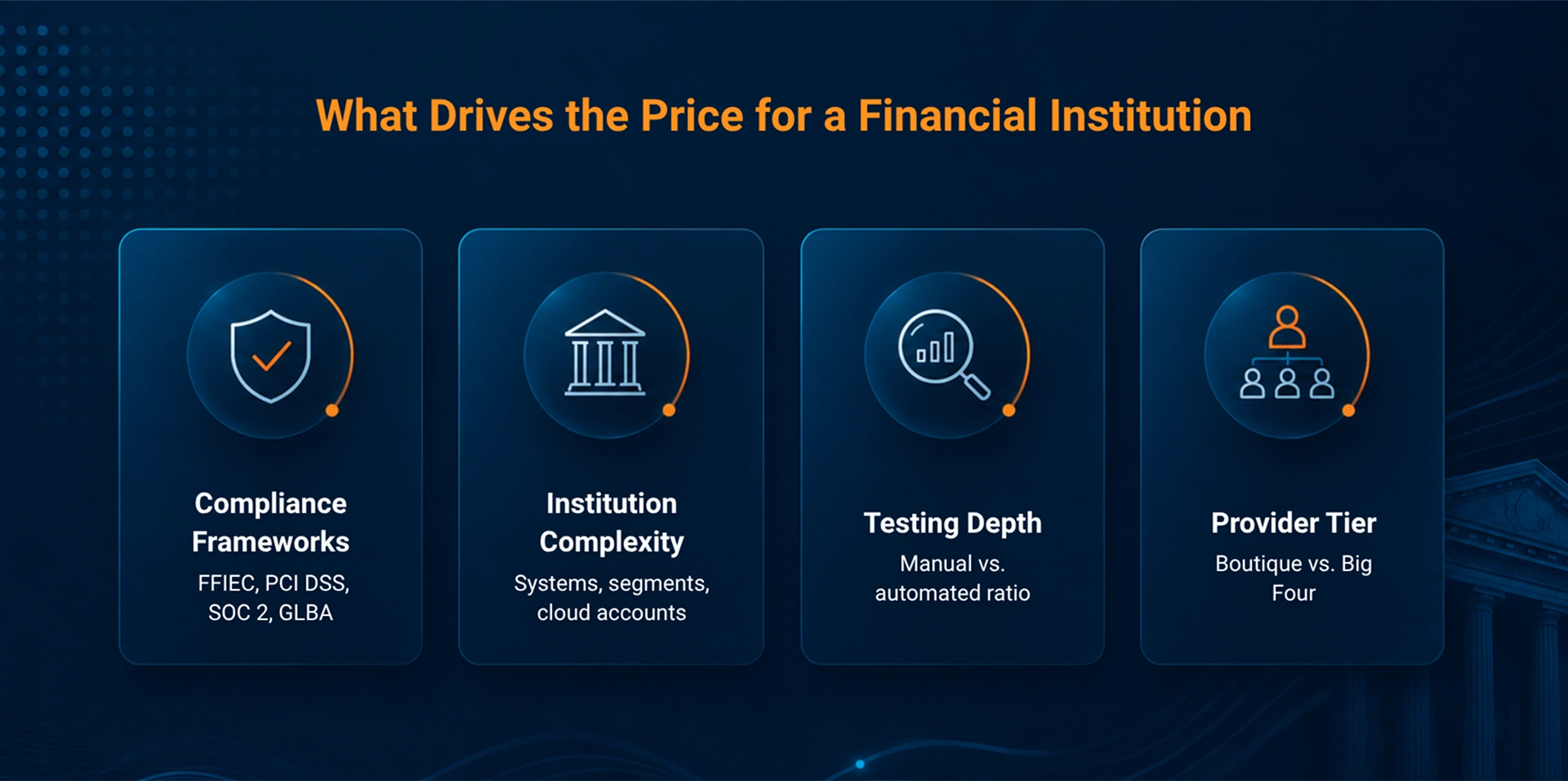
What Drives the Price for a Financial Institution
Institution Size and Environment Complexity
The number of externally facing systems, internal network segments, applications, cloud accounts, and user roles in scope drives hours more than any other factor. A single-branch community bank with a hosted core system tests very differently from a regional bank running its own data center alongside multiple cloud environments.
Testing Depth and Methodology
Genuine manual penetration testing, five to ten days of skilled consultant time working through exploitation and business logic, costs more than automated scanning repackaged as a report. Examiners and Qualified Security Assessors distinguish between automated scanning and penetration testing. PCI DSS Requirement 11.4 calls for a full penetration test that goes beyond a dynamic application security testing (DAST) scan.
Provider Tier
Pricing varies by provider tier. Boutique firms may charge $4,000 to $25,000 for a penetration test, while mid-tier firms may charge $10,000 to $50,000. Big Four consulting firms can charge two to three times as much for comparable scope. Actual pricing depends on the systems tested, testing depth, reporting requirements, and provider.
Typical 2026 Budget Ranges by Institution Type
These ranges are planning estimates based on general penetration testing price guides and the potential additional scope associated with each institution type. Actual costs depend on the systems tested, applicable compliance requirements, testing depth, and reporting needs. Treat these figures as planning guidance rather than verified industry averages.
| Institution Type | Typical Annual Range | What Drives the Range |
|---|---|---|
| Community bank or credit union | $8,000 – $20,000 | External and internal network testing, FFIEC-aligned reporting for a single-location or small-footprint environment |
| Regional or mid-size bank | $20,000 – $50,000 | Broader network segmentation, online and mobile banking application testing, social engineering |
| Large bank or bank holding company | $50,000 – $150,000+ | Multi-site infrastructure, red team components, continuous or quarterly testing cadence |
| Fintech or neobank | $15,000 – $40,000 | API and application-heavy scope, cloud infrastructure, SOC 2 evidence requirements |
| Payment processor or core platform vendor | $25,000 – $75,000+ | PCI DSS service provider status, six-month segmentation testing under Requirement 11.4.6 |
Use this table as a planning baseline, not a quote. Get a scoped estimate before finalizing any budget line, since the specific mix of systems, applications, and frameworks in your environment moves the number in either direction.
The Case for Building This into the Budget Proactively
Penetration testing earns its place in the budget well before the ROI conversation, since examiners and auditors expect it regardless. That said, the numbers make the investment case straightforward.
IBM's 2026 Cost of a Data Breach Report puts the global average breach cost at $4.99 million, up 12% from the previous year. The average cost in the United States reached $11.5 million. Financial services recorded an average breach cost of $6.29 million, second only to healthcare at $6.64 million. These figures highlight the financial exposure institutions face when security controls fail.
The threat data backs up why financial institutions stay a consistent target. Verizon's 2026 Data Breach Investigations Report recorded 3,809 security incidents in the financial and insurance sector, including 1,300 with confirmed data disclosure. Financial motivation was present in 98% of the reported breaches, while 81% involved System Intrusion, Social Engineering, or Everything Else. These findings reinforce the need to assess the attack paths that could expose financial systems and customer data.
Also Read: Prompt Injection Attacks Threaten Banking AI Chatbots: A Pentester's Guide
Getting the Most from a Single Engagement
The most efficient path for an institution carrying multiple frameworks is a single engagement scoped to produce evidence for all of them at once, rather than separate tests for FFIEC, PCI DSS, and SOC 2 run on different calendars. A tester who understands each framework's evidence standard can structure one methodology, one reporting package tailored per audience, and one retest cycle that satisfies an examiner, a QSA, and an auditor without three separate invoices.
Building this properly starts with three questions:
- Which frameworks apply to this institution today, and which ones are coming (a new payment product, a SOC 2 push tied to a partnership)?
- What is in scope- external network, internal network, web and mobile applications, cloud infrastructure, segmentation, social engineering?
- What does the report need to prove, and to whom: the board, an FFIEC examiner, a QSA, or a SOC 2 auditor?
Answering these before requesting quotes turns a wide market range into a specific, defensible number.
Get a Scoped Estimate
The ranges above give a planning baseline. The gap between that baseline and your actual invoice almost always traces back to a handful of factors that did not make it into the original scoping call.