Framework-Based Approach to AI Risk Assessment
Contributors

AI risk assessment is no longer theoretical or purely compliance driven. It has become a systems discipline that directly affects how AI initiatives scale, fail, or survive regulatory and operational scrutiny. Organizations using AI in important areas like regulations, revenue, or safety must not depend on casual checks or separate controls, as their use can lead to accumulating hidden risks.
This blog post is written for decision makers, AI leaders, and senior engineers responsible for approving, designing, or governing production of AI systems. It focuses on framework-based approaches that turn abstract AI risk into structured, defensible decisions that can be applied across the AI lifecycle.
What Is an AI Risk Assessment Framework?
An AI risk assessment framework is a structured decision system that defines how AI risk is identified, evaluated, owned, and managed across the AI lifecycle.
At its core, a framework establishes structure and accountability. It clarifies who is responsible for risk decisions, how trade-offs are evaluated, and when escalation or intervention is required.
TRiSM provides the technical enforcement layer that turns this governance into practice. It operationalizes framework intent through runtime controls, continuous validation, monitoring, and reporting, applied consistently across AI stacks and business units.
A framework comprises the following:
- Governance structure: Defined roles, decision authority, and escalation paths
- Risk taxonomy and classification: Standardized risk categories, levels, and rating criteria
- Assessment methodology: Defined steps, tools, templates, and measurement standards
- Acceptance criteria and decision thresholds: Risk tolerance, approval rules, and trade off boundaries
- Monitoring and continuous assessment plan: Metrics, review frequency, alert thresholds, and reassessment triggers
- Documentation and audit trail: Assessment records, decisions, change history, and incident logs
Why Structured AI Risk Assessment Frameworks Matter
AI systems behave differently by design. The same input can generate different outputs depending on model state, randomness, and context. Behavior is learned from data rather than explicitly programmed, which produces emergent outcomes that cannot be exhaustively predicted or debugged in the traditional sense.
This shift fundamentally changes what risk assessment must be accounted for. The classic confidentiality, integrity, and availability model does not fully capture AI risk.
Structured frameworks impose discipline where AI systems introduce ambiguity. They force explicit ownership for model intent, data provenance, system behavior, and failure response.
These frameworks, however, are a part of the holistic AI risk assessment process.
Explore AI risk assessment process in detail: Everything You Need to Know About AI Risk Assessment
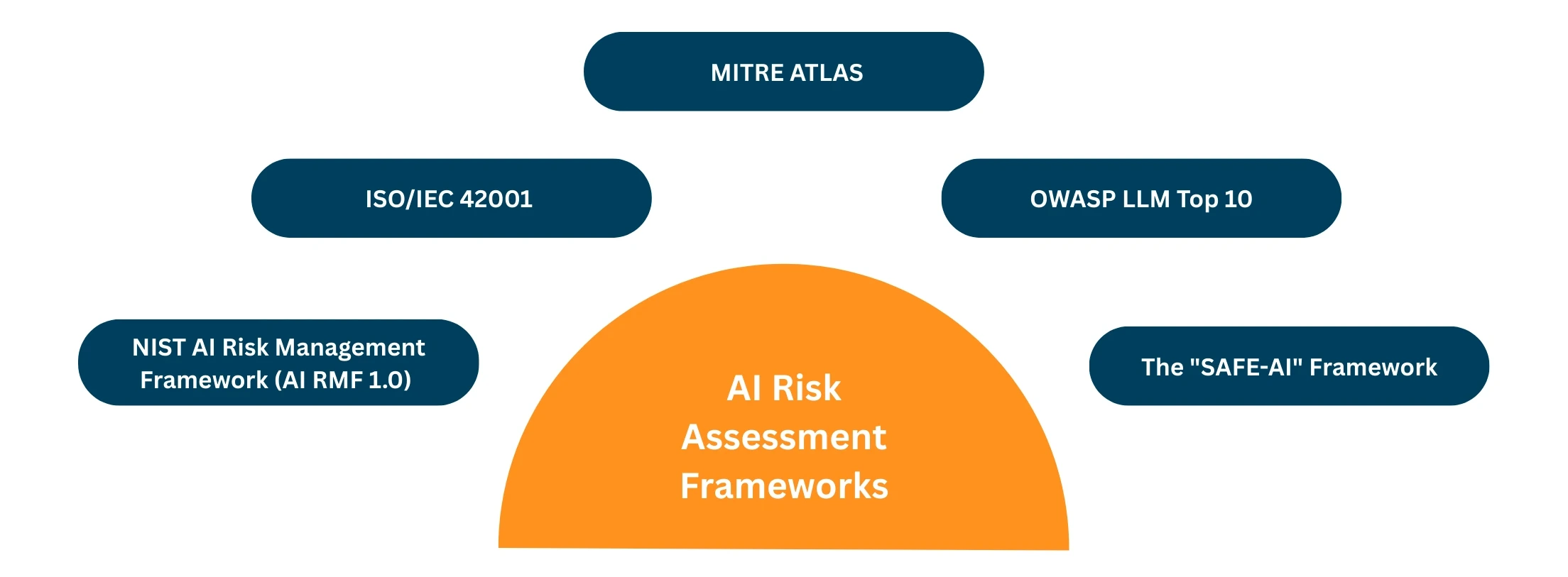
Key AI Risk Assessment Frameworks
NIST AI Risk Management Framework
The NIST AI Risk Management Framework is the most comprehensive and pragmatic foundation available today for managing AI risk at scale. Its strength is not in prescribing controls, but in structuring how organizations think, decide, and govern AI risk across the entire lifecycle.
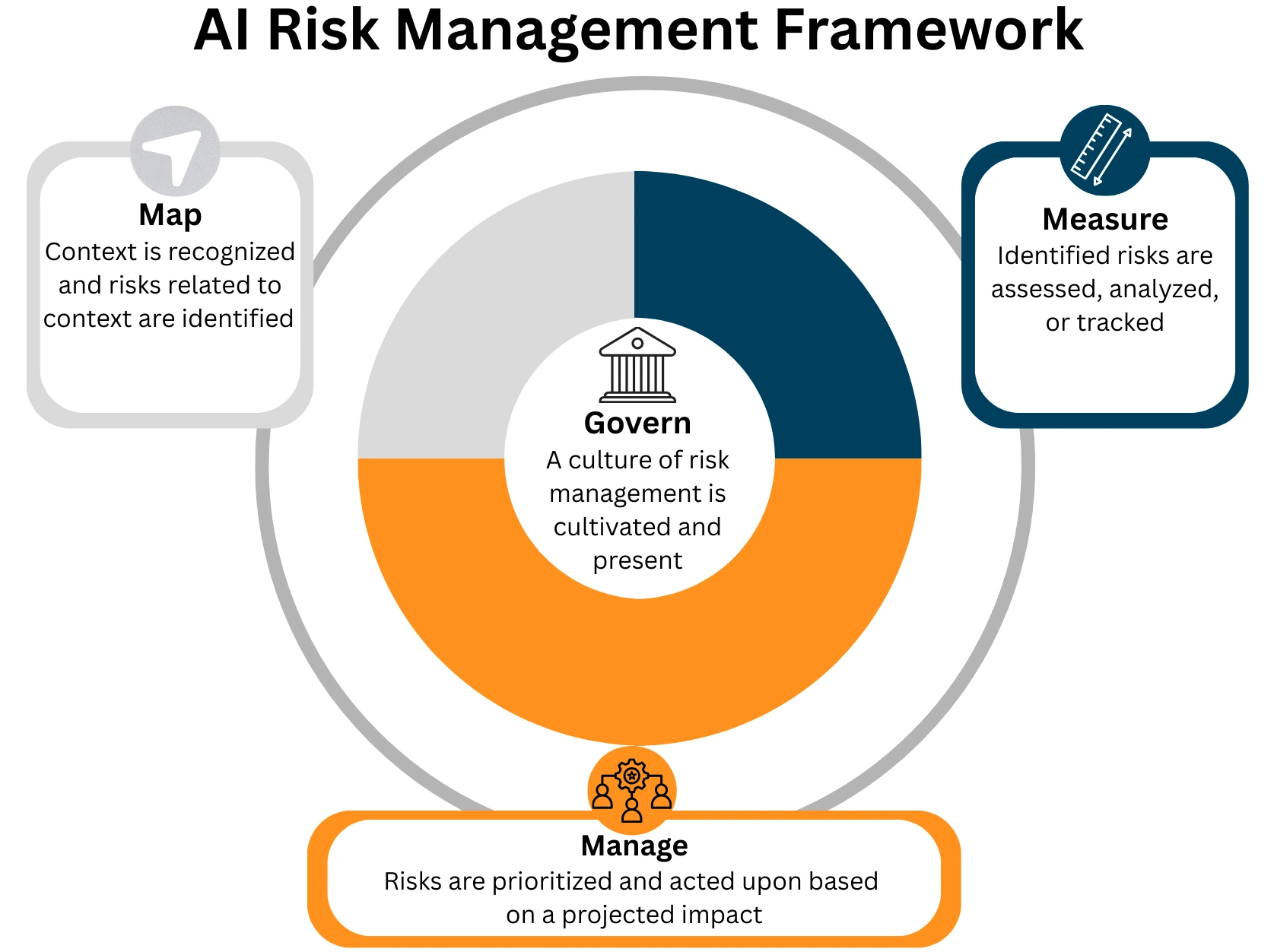
The NIST AI RMF is the dominant framework in the US, emphasizing a lifecycle approach.
- Govern: Assigns ownership, approval authority, and escalation paths for AI systems in production.
- Map: Defines system intent, affected users, data sources, assumptions, autonomy level, and usage boundaries.
- Measure: Evaluates bias, reliability, robustness, security, and drift through continuous evaluations spanning model quality, security abuse cases, and policy compliance, with results logged as auditable evidence.
- Manage: Enforces risk controls through runtime enforcement layers, including AI gateways, guardrail and guardian patterns, incident response workflows, retraining triggers, and controlled system retirement.
Source: atlas.mitre.org
ISO/IEC 42001 (AI Management System)
ISO/IEC 42001 complements AI risk assessment frameworks by standardizing how AI risk is governed, audited, and continuously improved across the organization. This standard formalizes how organizations govern AI across policy, roles, controls, audits, and continuous improvement.
ISO/IEC 42001 primarily defines an organizational management system. It does not, on its own, specify technical runtime controls or enforcement mechanisms for AI systems.
In practice, an AI management system helps organizations:
Define clear ownership and decision authority for AI use
Systematically identify and assess AI-related risks
Enforce transparency and accountability across teams
Control data quality and monitor model performance
Address ethical, legal, and societal impact requirements
Monitor and govern AI systems across their lifecycle
Source: www.iso.org
MITRE ATLAS
MITRE ATLAS focuses on adversarial threats against AI systems, extending traditional threat modeling to account for how machine learning models can be manipulated, degraded, or exploited.
In practice, it helps organizations:
- Identify AI-specific attack techniques such as data poisoning, prompt injection, evasion, and model extraction
- Map adversarial behaviors across the AI lifecycle, from data collection and training to inference and deployment
- Analyze threat paths that exploit model behavior rather than software vulnerabilities
- Design defensive controls aligned to real-world attacker tactics, not hypothetical risks
- Integrate AI threats into security operations alongside traditional cyber threat models
MITRE ATLAS does not replace AI risk assessment frameworks. It complements them by providing tactical threat intelligence required to secure AI systems against deliberate misuse and attack.
Source: atlas.mitre.org
Together, MITRE ATLAS and the OWASP LLM Top 10 guide adversarial testing, threat modeling, and runtime defense design, shaping security test cases, guardrail coverage, and abuse detection for AI systems in production.
The "SAFE-AI" Framework Alignment
SAFE-AI is designed to help organizations secure AI-enabled systems by identifying and addressing AI-specific threats and concerns systematically, not by treating AI like traditional software.
Here is what SAFE addresses:
- AI-specific threat expansion: Adversarial inputs, poisoning, bias exploitation, decision manipulation, and data leakage.
Supply chain vulnerabilities: Risk from third-party models, datasets, and tools with unclear provenance.
Assessment-grade control alignment: AI threats mapped to security controls, such as NIST SP 800-53, with testable controls, defined verification steps, and auditable evidence across pre-production and runtime.
Source: atlas.mitre.org
OWASP LLM Top 10
OWASP LLM Top 10 complements AI risk assessment frameworks by providing a standardized taxonomy of LLM-specific security risks that must be evaluated within broader governance and risk management structures.
LLMs introduced an entirely new attack surface. Prompt injection, data leakage, insecure output handling, and overprivileged agents are not edge cases. They are default failure modes.
Here is how OWASP LLM Top 10 becomes valuable in an AI risk assessment framework.
- Captures critical LLM vulnerabilities (different from general AI)
Provides practical defenses for each
Enables systematic risk assessment (map these risks for your LLM application)
Essential if your organization uses or plans to use LLMs
Free guidance from the trusted OWASP organization
Frameworks vs Capability Layers
AI risk assessment frameworks define governance and decision logic. Risk reduction happens only when those requirements are enforced through concrete technical capabilities.
In practice, frameworks map to the following implementation layers across the AI stack:
- AI Governance: Policy definition, risk ownership, approval workflows, and escalation enforced across teams.
- AI Security Posture Management (AI-SPM): AI asset discovery, inventory, configuration visibility, and misconfiguration-driven risk detection.
- Information Governance: Data access controls, retention enforcement, lineage tracking, and oversharing prevention across training and inference.
- AI Runtime Defense: Inference guardrails, prompt and response filtering, anomaly detection, PII redaction, and real-time blocking.
- AI Usage Control: Governance of embedded and external AI usage, including shadow AI detection and policy enforcement.
- AI Security Testing: Continuous offensive testing for prompt injection, jailbreaks, model inversion, data leakage, and abuse patterns.
- AI Supply Chain and AI-BOM: Provenance and integrity tracking for models, datasets, tools, and third-party dependencies.
Frameworks define intent. Capability layers determine whether that intent survives contact with production.
While frameworks provide structure, effective AI risk assessment depends on how they are applied in practice. Strategy, prioritization, and operational discipline determine whether these frameworks enable scale or become documentation overhead.
In our upcoming webinar, we focus on practical AI risk assessment strategies and best practices drawn from real deployments, showing how organizations translate frameworks into repeatable, defensible risk decisions.

The Bottom Line: Why Leaders Need This
- Risk is manageable with structure: Framework turns vague "AI is risky" into concrete, actionable processes
- Scale without chaos: Framework enables organization to deploy 100+ models confidently, not 5 models carefully
- Regulatory defense: Documented process + governance records = defensible position if regulators investigate
- Competitive advantage: Organization with governance moves faster (clear approval), safer (catches issues early), and more trustworthy (can prove it)
- Accountability: Clear roles, decision records, and ownership prevent finger-pointing when issues arise


Other Popular Articles
In the digital age, businesses must adopt an ad
GRC is the capability, or integrated collection
Get the latest insights straight from our desk to your inbox.
Other Featured Articles
Explore More
What Is CMMC and Do You Need It?
Learn what CMMC is, who needs it, and how to determine if your business requires Level 1 compliance for DoD contracts.
Shantanoo Govilkar
SVP Strategic Solutions Risk & Cybersecurity Solutions view
CMMC Level 1 vs Level 2, Which Applies to You?
Learn the key differences between CMMC Level 1 and Level 2, understand FCI vs. CUI, and determine which CMMC level your DoD contract requires to avoid unnecessary costs or compliance risks.
Shantanoo Govilkar
SVP Strategic Solutions Risk & Cybersecurity Solutions view
What CMMC Means for DoD Subcontractors
Understand what CMMC means for DoD subcontractors, how compliance requirements flow down from prime contractors, who must comply, and the steps to determine your CMMC obligations.
Shantanoo Govilkar
SVP Strategic Solutions Risk & Cybersecurity Solutions view
How to Complete Your CMMC Level 1 Self Assessment
Complete CMMC Level 1 self-assessment guide: define scope, work through 15 practices, fix common gaps, and submit your SPRS affirmation.
Shantanoo Govilkar
SVP Strategic Solutions Risk & Cybersecurity Solutions view
The October 2026 CMMC Deadline: What Happens If You Miss It
Prepare for the October 2026 CMMC deadline. Learn how compliance affects DoD contract eligibility, SPRS affirmations, renewals, and subcontractors.
Shantanoo Govilkar
SVP Strategic Solutions Risk & Cybersecurity Solutions view
Operational Technology (OT) Penetration Testing Guide for Ransomware Defense
Ransomware doesn't need to breach your control room it needs to get close enough that you can't trust it hasn't.
Shantanoo Govilkar
SVP Strategic Solutions Risk & Cybersecurity Solutions view
A Medical Device Maker's Guide to FDA Cybersecurity Testing for 510(k) & PMA
The FDA doesn't publish a pen testing checklist, but its guidance, 524B requirements, and reviewer expectations add up to one.
Shantanoo Govilkar
SVP Strategic Solutions Risk & Cybersecurity Solutions view
Pharma Pen Testing: Why FDA and IP Risk Need Different Scoping
Standard pen test scoping frameworks weren't built for pharma.
Shantanoo Govilkar
SVP Strategic Solutions Risk & Cybersecurity Solutions view
FDA 524B Is Here: What Medical Device Makers Must Test Now
Section 524B made medical device cybersecurity a legal requirement, not a guideline.
Shantanoo Govilkar
SVP Strategic Solutions Risk & Cybersecurity Solutions view
Why CHIPS Act Manufacturers Can't Rely on CMMC Pen Testing Alone
Semiconductor manufacturers face dual compliance obligations under CMMC 2.0 and the CHIPS Act and a standard pen test satisfies neither fully.
Shantanoo Govilkar
SVP Strategic Solutions Risk & Cybersecurity Solutions view
Why Pen Test Evidence Fails C3PAO Assessments (and How to Fix It)
Completing a pen test isn't enough for CMMC.
Shantanoo Govilkar
SVP Strategic Solutions Risk & Cybersecurity Solutions view
PTaaS vs. Annual Pen Testing: Why Manufacturers Are Switching
Annual penetration testing produces documentation, not security.
Shantanoo Govilkar
SVP Strategic Solutions Risk & Cybersecurity Solutions view
Map Your OT Attack Surface Before the Next Audit
Don't wait for an auditor to tell you what you missed.
Shantanoo Govilkar
SVP Strategic Solutions Risk & Cybersecurity Solutions view
How to Scope IT-OT Penetration Testing Safely
Learn how to safely scope IT-OT penetration testing engagements.
Shantanoo Govilkar
SVP Strategic Solutions Risk & Cybersecurity Solutions view
How Often Should Manufacturers Run OT Penetration Testing?
Annual pen testing fits a budget cycle but it doesn't reflect how fast manufacturing environments actually change.
Shantanoo Govilkar
SVP Strategic Solutions Risk & Cybersecurity Solutions view
Pharmaceutical Pen Testing: What 21 CFR Part 11 and cGMP Require
21 CFR Part 11 and cGMP don't mention penetration testing but the controls they require depend on it.
Shantanoo Govilkar
SVP Strategic Solutions Risk & Cybersecurity Solutions view
Pharmaceutical Pen Testing: Why R&D and GxP Need Different Scopes
R&D and GxP regulated environments have different risk profiles, compliance requirements, and testing constraints.
Shantanoo Govilkar
SVP Strategic Solutions Risk & Cybersecurity Solutions view
Why Pharmaceutical Pen Testing Must Address Nation-State Threats
Nation-state actors treat pharma like critical infrastructure targeting formulation data, synthesis routes, and clinical IP with patience and precision.
Shantanoo Govilkar
SVP Strategic Solutions Risk & Cybersecurity Solutions view
How Ransomware Crosses the IT-OT Boundary (And How to Stop It)
Ransomware operators target the IT-OT boundary deliberately and they know manufacturing economics well.
Shantanoo Govilkar
SVP Strategic Solutions Risk & Cybersecurity Solutions view
Where Industry 4.0 Left Your OT Attack Surface Wide Open
Industry 4.0 connected OT environments were never built for. Learn why traditional IT security tools fall short and what OT penetration testing reveals that audits miss.
Shantanoo Govilkar
SVP Strategic Solutions Risk & Cybersecurity Solutions view
What AS4 Actually Solves: Real Outcomes Companies See After Migration
Discover what AS4 actually solves for modern businesses. Learn the real outcomes companies achieve after migration, from stronger security to better B2B integration performance.
EDI Solutions Group
Marketing Group view
7 Migration Pitfalls That Derail AS4 Upgrades (and How to Avoid Them)
Avoid costly AS4 upgrade mistakes. Discover 7 migration pitfalls that delay projects, create risk, and disrupt B2B messaging, plus practical ways to avoid them.
EDI Solutions Group
Marketing Group view
How to Perform Penetration Testing in Cloud Environments (AWS, Azure, and GCP) - 2026 Edition
A practical guide to cloud penetration testing across AWS, Azure, and GCP. Learn methods, tools, and best practices to identify vulnerabilities and improve security.
Cybersecurity Solutions Group
Marketing Group view
5 Signs It's Time to Move Legacy EDI Environment to AS4 Protocol
Partner onboarding delays, compliance gaps, and rising maintenance costs are signals your EDI infrastructure is reaching its limits. Learn the five signs it is time to evaluate a move to AS4.
EDI Solutions Group
Marketing Group view
How to Design Custom Chatbots That Cannot “Make Stuff Up”
Confident AI answers without traceable sources create institutional risk. Learn how Grounded RAG architecture retrieves real documents first and attaches verifiable citations to every response.
Data and AI Solutions Group
Marketing Group view
How Citation-Backed Conversational AI Improves Public Access and Internal Decision-Making
AI without source citations creates real liability. Learn how citation-backed AI brings traceable sources, version awareness, and audit-ready outputs to every institutional decision.
Data and AI Solutions Group
Marketing Group view
How to Perform a Successful Network Penetration Test: Comprehensive Guide for 2025
Learn how to perform a successful network penetration test to identify vulnerabilities, simulate real cyberattacks, and strengthen your organization’s network security.
Cybersecurity Solutions Group
Marketing Group view
What Is Penetration Testing? A 2026 Expert Guide
A 2026 expert guide to penetration testing for security leaders and IT teams seeking proactive defense, compliance, and stakeholder trust.
Cybersecurity Solutions Group
Marketing Group view
OT Ransomware Prevention: Practical Best Practices for Industrial Cybersecurity
Explore enterprise grade OT ransomware prevention strategies, including segmentation, identity control, threat informed detection, and resilient recovery design to protect industrial operations fro
Cybersecurity Solutions Group
Marketing Group view
10 Myths About OT/ICS Security That Put Your Business at Risk
Think your OT network is secure? Learn the 10 most dangerous myths about OT and ICS cybersecurity that leave industrial operations exposed to attacks.
Cybersecurity Solutions Group
Marketing Group view
OT Ransomware Risks and Response for Industrial Systems
Learn why OT environments face higher ransomware risk, how attackers gain access, and how effective detection and response reduce operational impact.
Cybersecurity Solutions Group
Marketing Group view
AI Risk Assessment: Risk Types, Best Practices & More
Explore AI risk types, essential assessment frameworks, and proven best practices to mitigate threats in AI deployment. Learn actionable strategies for secure AI systems today.
Cybersecurity Solutions Group
Marketing Group view
AI Risk Assessment: Everything You Need to Know
Learn essential processes, methodologies, risk types, regulatory requirements, and practical implementation strategies for safe AI deployment.
Cybersecurity Solutions Group
Marketing Group view
Whitepaper: Ransomware Threat Management
Ransomware continues to be a real threat to business operations across all industries, no organization is safe from this threat.
Laszlo S. Gonc
CISSP, First Senior Fellow, DivIHN Cybersecurity Center of Excellence view
Cybersecurity Incident Response Preparedness
An incident response framework provides a structure to support incident response operations. A framework typically provides guidance on what needs to be done, but not on how it is done.
Laszlo S. Gonc
CISSP, First Senior Fellow, DivIHN Cybersecurity Center of Excellence view
IoT Medical Device Cybersecurity
Healthcare data and medical devices would be aggressively targeted by ransomware attacks since early 2017 has proven to be true