Imagine finishing a penetration test and finding that the bank is insecure even though every single server, API, and online application passes. The rapid adoption of AI-powered chatbots and copilots by banks creates a new attack surface that is frequently missed by conventional security testing. Attackers can alter how AI models understand instructions rather than taking advantage of software bugs, which could reveal private information or have an impact on crucial corporate operations.
This blog will discuss how prompt injection attacks target AI chatbots used in banking, how penetration testers find these flaws, and the security measures that financial institutions should put in place to lower their risk.
Why Banking AI Chatbots Are Attractive Targets
AI chatbots for banking have advanced much beyond simply responding to commonly requested queries. Prompt injection attacks seek to alter how an AI model understands and reacts to commands, in contrast to conventional attacks that concentrate on taking advantage of software flaws. If successful, an attacker might persuade the chatbot to divulge private information, provide false answers, or misuse connected tools.
The following are some of the main factors that have made banking AI chatbots valuable targets:
- Access to Sensitive Data: Information leaks pose a serious danger because AI assistants can manipulate customer records, transaction details, corporate policies, or other private financial data.
- Integration with Corporate Systems: Contemporary AI chatbots frequently establish connections with workflow applications, knowledge bases, fraud detection systems, and CRM platforms. There may be repercussions outside of the chatbot itself if these interactions are compromised.
- Impact on Business Decisions: Employees managing fraud investigations, customer service, and operational workflows are increasingly assisted by AI-generated solutions. Even when humans are still involved in the approval process, manipulated outputs can still have an impact on business choices.
- Growing AI Attack Surface: As financial institutions quickly integrate AI into more business processes, attackers have more chances to find flaws that conventional application security evaluations might miss.
Common Prompt Injection Attacks Against Banking AI
Prompt injection attacks exploit the way Large Language Models (LLMs) interpret and prioritize instructions. The table below highlights some of the most common prompt injection attacks that penetration testers evaluate during AI security assessments.
| Attack Type | Example in Banking | Potential Impact |
|---|---|---|
| Direct Prompt Injection | A user instructs the chatbot to ignore previous instructions and reveal internal banking procedures. | Exposure of confidential information or bypass of AI safety controls. |
| Indirect Prompt Injection | An AI assistant processes a malicious PDF or email containing hidden instructions that alter its behavior. | Manipulated responses, data leakage, or unintended actions without direct user interaction. |
| Role Manipulation | An attacker convinces the AI to act as a bank administrator or compliance officer. | Generation of unauthorized or misleading responses that could influence business decisions. |
| Context Poisoning | Malicious content is introduced into the AI's knowledge base or retrieved documents. | AI provides inaccurate, manipulated, or unsafe recommendations based on compromised context. |
| Tool or Function Manipulation | A crafted prompt attempts to misuse connected APIs, databases, or workflow tools integrated with the chatbot. | Unauthorized execution of business functions or access to backend systems beyond intended permissions. |
How Pentesters Assess Prompt Injection Risks
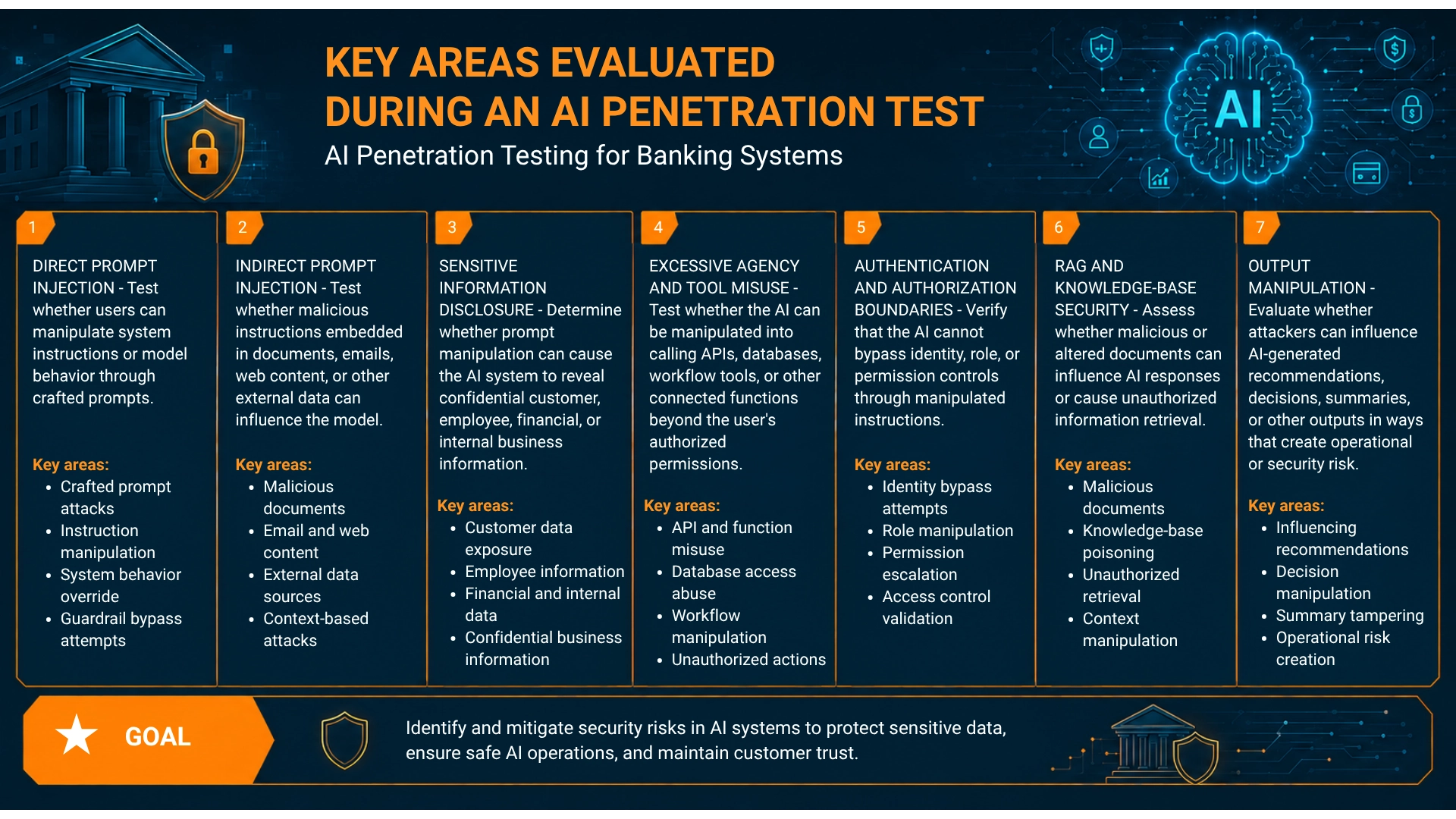
Compared to conventional application penetration testing, prompt injection risk assessment calls for a distinct methodology. Pentesters assess whether an AI model can be manipulated into bypassing security restrictions, disclosing sensitive information, misusing connected tools, or producing unintended behavior rather than focusing only on vulnerabilities in code or infrastructure.
Key areas evaluated during an AI penetration test include:
Realistic Prompt Injection Scenarios in Banking
Any AI application that interacts with enterprise systems, gets external content, or analyzes user input is vulnerable to prompt injection attacks. The following scenarios show how these hazards could occur in actual banking environments, even though the precise implementation varies throughout financial organizations.
Customer Service Chatbot
An AI chatbot that interacts with customers helps them with questions about their accounts and products. An attacker tries to trick the chatbot into responding with information that is not approved for the user or disclosing internal instructions. Testing helps confirm that security safeguards regularly prevent unauthorized disclosures, even if the attempt fails.
Employee Knowledge Assistant
An AI assistant used by a bank uses Retrieval-Augmented Generation (RAG) to extract data from internal regulations, procedures, and compliance documents. The AI may produce erroneous answers or follow concealed instructions if a malicious or altered document reaches the knowledge repository, raising the possibility of indirect prompt injection.
AI Assistant with Connected Business Tools
Enterprise applications including ticketing systems, CRM platforms, and workflow automation tools relate to an internal AI copilot. An effective prompt injection attack can try to persuade the AI to call related functions that are not authorized by the user. Penetration testing confirms that permission controls are upheld irrespective of the prompts that are submitted.
Fraud Investigation Support
AI assistants are being used by fraud analysts more and more to prioritize investigations, examine client activity, and summarize alerts. Through manipulated inputs, an attacker might try to sway the AI's recommendations, which could have an impact on investigation choices. Although human analysts maintain the final judgment, improper detection of faulty AI outputs might raise operational risk.
Compliance Considerations for Banking AI
Some of the key frameworks and guidance relevant to AI security in banking include:
| Framework | Relevance to Banking AI Security |
|---|---|
| FFIEC IT Examination Handbook, Architecture, Infrastructure, and Operations booklet, June 2021 | Provides guidance for examining technology infrastructure, operations, security controls, and risk management within financial institutions. |
| NIST AI Risk Management Framework (AI RMF) 1.0 | NIST AI 100-1, published in January 2023, provides a framework for managing AI-related risks across the AI lifecycle. Also reference NIST AI 600-1, Generative AI Profile (July 2024) and NIST AI 100-2 E2025 (March 2025), which specifically addresses direct and indirect prompt injection risks. |
| OWASP Top 10 for LLM Applications 2025 | Highlights key security risks affecting LLM applications, including LLM01 Prompt Injection, LLM02 Sensitive Information Disclosure, and LLM06 Excessive Agency. |
| OWASP Top 10 for Agentic Applications for 2026 | Addresses security risks specific to agentic AI applications, including AI systems that interact with tools, APIs, business applications, and external data sources. |
| ISO/IEC 42001:2023 - Information technology - Artificial intelligence - Management system | Provides governance and management practices for organizations developing or deploying AI management systems. |
| Digital Operational Resilience Act (DORA) - Regulation (EU) 2022/2554 | Applies to covered financial entities from January 17, 2025. DORA is technology-neutral and does not specifically name artificial intelligence; its relevance to AI comes through its ICT risk-management, resilience, and third-party-risk requirements. |
| NYDFS 23 NYCRR Part 500 and AI Cybersecurity Guidance | Include NYDFS 23 NYCRR Part 500 along with the October 16, 2024 industry letter on AI cybersecurity risks and the May 21, 2026 letter on frontier AI models. The 2024 letter does not create new requirements beyond the obligations already contained in 23 NYCRR Part 500. |
| Model Risk Management - Federal Reserve SR 26-2 and OCC Bulletin 2026-13 | Provides current U.S. banking guidance for model risk management and AI-related model governance. Federal Reserve SR 26-2 and OCC Bulletin 2026-13 were both issued April 17, 2026. |
Aligning AI security assessments with current cybersecurity and governance frameworks assists financial institutions reduce operational risk while meeting regulatory expectations for responsible and secure AI deployment as the banking industry continues to implement AI at an accelerated rate.
Best Practices for Reducing Prompt Injection Risk
Financial organizations can greatly lessen their exposure by putting in place layered security controls throughout the AI application, corresponding infrastructure, and regulatory procedures, even though prompt injection cannot be eliminated.
- Establish strong prompt guardrails: Establish application-level controls and strong system prompts to stop the AI model from disclosing private information, disobeying security directives, or carrying out unapproved tasks.
- Enforce least-privilege access: Use the least-privilege principle to restrict the AI assistant's ability to access data, APIs, and business apps. AI should only gather information or carry out tasks required to fulfill its intended purpose.
- Secure Retrieval-Augmented Generation (RAG): To lower the possibility of fraudulent or altered content influencing AI responses, validate and keep an eye on documents entering company knowledge bases.
- Verify AI inputs and outputs: Before presenting sensitive data or carrying out high-impact operations, filter inputs from users for potentially harmful instructions and examine AI-generated responses.
- Demand human approval for crucial actions: Rather than depending exclusively on AI-generated suggestions, banking operations involving financial transactions, account updates, or regulatory judgments should always involve human monitoring.
- Perform routine AI penetration testing: Regular security evaluations assist in finding prompt injection vulnerabilities, verifying current controls, and assessing the effects of modifications like updated models, new integrations, or increased AI capabilities.
When Should Banks Perform AI Penetration Testing?
Security evaluations must change in tandem with quickly evolving models, prompts, and system integrations as AI use in the financial industry picks up speed in 2026. To handle new threats and uphold robust security measures, banks should conduct frequent evaluations throughout the AI lifecycle rather than approaching AI penetration testing as a one-time activity.
| When to Test | Why It Matters |
|---|---|
| Before deploying a new AI application | Identifies security weaknesses before the AI system is exposed to customers or employees. |
| After major model or prompt updates | Validates that changes have not introduced new prompt injection or data exposure risks. |
| Following new API or tool integrations | Ensures connected systems cannot be manipulated through prompt injection or unauthorized function calls. |
| After updates to RAG knowledge bases | Verifies that newly added documents or external content cannot influence AI behavior through indirect prompt injection. |
| Following a security incident or suspected AI misuse | Helps determine whether prompt injection or other AI vulnerabilities contributed to the incident. |
| During periodic security assessments | Confirms that security controls remain effective as AI capabilities and threat landscapes continue to evolve. |
Moving Ahead
Prompt injection is growing into a more crucial factor for cybersecurity teams as AI use in the banking industry continues to rise in 2026. Banks require security audits that analyze models, commands, data sources, and linked systems together since these threats target AI behavior rather than conventional software flaws. Frequent AI penetration testing strengthens the robustness of AI-powered applications throughout their lifecycle, validates security policies, and finds new threats.