Penetration Testing Services
Senior penetration testers use real attacker techniques to find exploitable weaknesses and validate your controls. You see exactly how an attacker moves through your environment, before one does.
Testing That Matches Your Stack
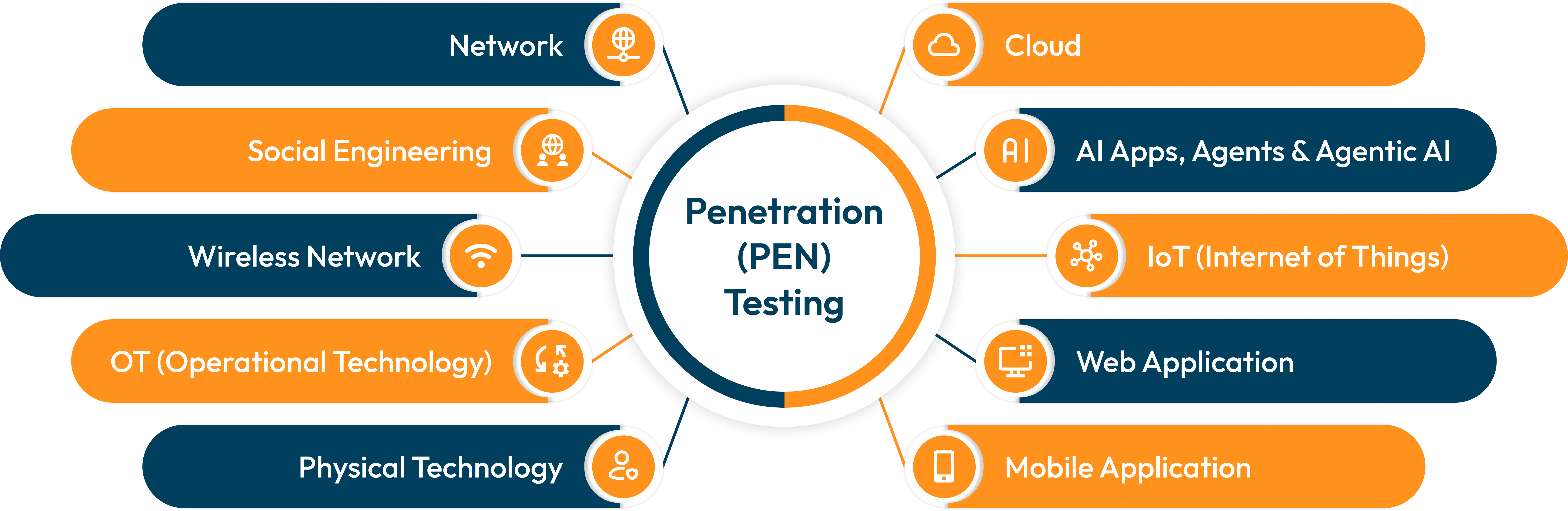
Coverage maps to what you actually run: cloud infrastructure, identity providers, internal networks, web applications, APIs, operational technology and industrial control system (OT/ICS) environments, and the AI services and integrations added in the past year. Every scope starts with a threat model built around your specific architecture, your stack, and your risk priorities.
What Your Environment Hides
The threat landscape evolves constantly. AI integrations, third-party connections, and business platforms create new exposure faster than most testing programs adapt. Staying ahead starts with knowing where attacker activity has outpaced your current coverage.

Attackers are actively probing AI endpoints, model APIs, and agent workflows. 13% of organizations reported breaches of AI models or applications, 97% of which lacked proper AI access controls (IBM, July 2025).

Overprivileged accounts, stale credentials, and ungoverned service identities sit across every environment we test. Any one of them is enough for an attacker to move laterally.

Third-party connections inherit trust by default. One compromised vendor or misconfigured integration gives an attacker a direct path into your environment. Third-party involvement in breaches has reached 48% (Verizon, 2026).
How We Run Every Engagement
Every engagement is led end-to-end by senior, certified penetration testers with real-world depth in SOC operations, incident response, OT/ICS, and vulnerability management. AI speeds up workflows and reporting, but the technical team validates every output and makes every call. We frame results against business risk so teams get something actionable.
Scoping the Right Model

We start with minimum details. Everything else gets discovered the way an attacker would discover it.

We start with limited access and work from there. Built for organizations that want to know how far an attacker already inside can reach.

Full access from the start. We go deeper, faster, and cover more ground than any other model.
What You Walk Away With

A board-ready summary of what we found, framed around business risk. Written for leadership, not the security team.

A full breakdown of every vulnerability with reproduction steps, evidence, and remediation guidance the security team can act on directly.

The signed letter you hand to auditors or customers as proof a test was completed.
How We Stay Involved

Every vulnerability ships with a ready-made fix from the Quick Fix Library, the set of vetted remediation steps for your highest-impact and most critical exposures.

We stay available while your team works through the vulnerabilities. If something is unclear or needs more context, we are a call away.

Security questions come up after every engagement. We stay accessible for follow-up conversations, whether that is a board briefing, a vendor decision, or a vulnerability that needs more explanation.

Once remediation is complete, the penetration testers validate every fix and deliver an updated report with confirmed closure.
Resources from DivIHN
Everything here helps you make a more informed decision about your next penetration test.

Learn what CMMC is, who needs it, and how to determine if your business requires Level 1 compliance for DoD contracts.
Learn the key differences between CMMC Level 1 and Level 2, understand FCI vs. CUI, and determine which CMMC level your DoD contract requires to avoid unnecessary costs or compliance risks.

Understand what CMMC means for DoD subcontractors, how compliance requirements flow down from prime contractors, who must comply, and the steps to determine your CMMC obligations.
Evidence Your Auditor Accepts
Every deliverable serves as audit evidence. Each result maps directly to the specific controls your assessor checks, test procedures support your evidence requirements, and remediation guidance references the framework language your auditor works from.
US-originated standard, governed by the AICPA. Widely required across US SaaS and enterprise vendors.
A global standard, heavily enforced in the US by card brands and acquiring banks
US federal law. Mandatory for all covered entities and business associates operating in the US healthcare space.
US Department of Defense requirement. In force since November 10, 2025, with Level 2 certification required from November 10, 2026. Applies to defense suppliers handling federal contract information or controlled unclassified information.
Developed by NIST, a US federal agency. Currently voluntary but rapidly becoming the baseline standard for AI governance in the US, especially for federal contractors.
Secure on Paper, Breached in Practice
Each vulnerability was live in production at the time of discovery.
Note: Client details anonymized.

A misconfigured Azure storage container exposed PHI for 18 months. Monthly automated scans ran the entire time. Our penetration testers found it manually in week one.

Misconfigured group policies and unconstrained Kerberos delegation turned a help desk account into full domain access. Existing monitoring missed the attack path entirely.

A broken object-level authorization flaw in a production API exposed every customer record. The platform had passed a SOC 2 audit three months earlier.
Get Actionable Intelligence Straight From Penetration Testers
Get insights, threat updates, and resources matched to your role and priorities. Everything we publish, relevant to you, straight to your inbox.