CMMC Level 1 sets the baseline cybersecurity requirements for organizations that handle Federal Contract Information (FCI) as part of certain DoD contracts. For logistics and transportation companies, that can include carriers, freight brokers, third-party logistics providers, warehouse operators, and transportation subcontractors that manage shipments, coordinate deliveries, or support defense contractors.
This blog explains the CMMC Level 1 requirements and what they can look like in day-to-day transportation operations. It covers how to determine whether Level 1 applies to your company, where FCI can move through your environment, why remote access and third-party connections deserve attention, and how physical security fits into the picture.
Also Read: CMMC Level 1: Guides, Briefs, and Practical Compliance Knowledge
Does CMMC Level 1 Apply to Your Transportation Company?
The first question is not simply, "Do we work with the DoD?" Instead, start with your contract and the information your company handles as part of that work. FCI is information that is not intended for public release and is provided by or generated for the government under a contract to develop or deliver a product or service.
For a transportation company, that information could show up in shipment instructions, delivery schedules, customer communications, contract documentation, or other nonpublic information associated with a federal contract. This can also affect subcontractors. A transportation company working under a DoD prime contractor may have CMMC obligations of its own. If the subcontractor handles FCI but not CUI, Level 1 may be applicable. If it handles CUI, the requirements can move to Level 2.
So before buying new security tools or rewriting policies, take a close look at your contracts. Understanding what information you actually receive and what the contract requires gives you a much better starting point.
What Are the CMMC Level 1 Requirements?
CMMC Level 1 includes 15 requirements based on FAR 52.204-21. For a logistics or transportation company, those requirements translate into everyday security practices:
- Control access: Make sure only authorized people can access systems containing FCI.
- Limit user functions: Give employees only the system access and capabilities they actually need.
- Control external connections: Know which outside systems connect to your environment and manage those connections.
- Protect publicly accessible systems: Control what information is exposed through public-facing systems.
- Identify users, processes, and devices: Know who or what is accessing relevant systems.
- Authenticate access: Verify users, processes, and devices before granting access.
- Protect system media: Sanitize or destroy media containing FCI before it is disposed of or reused.
- Control physical access: Protect relevant systems and equipment from unauthorized physical access.
- Manage visitors: Escort and monitor visitors where necessary.
- Maintain audit logs: Keep appropriate records of system activity.
- Control remote access: Manage who can connect remotely and how those connections are handled.
- Protect remote sessions: Safeguard information during remote connections.
- Use managed access points: Route remote access through controlled access mechanisms.
- Control wireless access: Manage wireless connections to relevant systems.
- Protect against malicious code: Maintain protections, scanning, and updates to defend against malware.
Where Does FCI Move in a Transportation Environment?
FCI does not necessarily stay in one place. A shipment request might arrive through email, move into a transportation management system, be reviewed by a dispatcher, passed to a carrier, accessed by a driver, and eventually become part of delivery documentation.
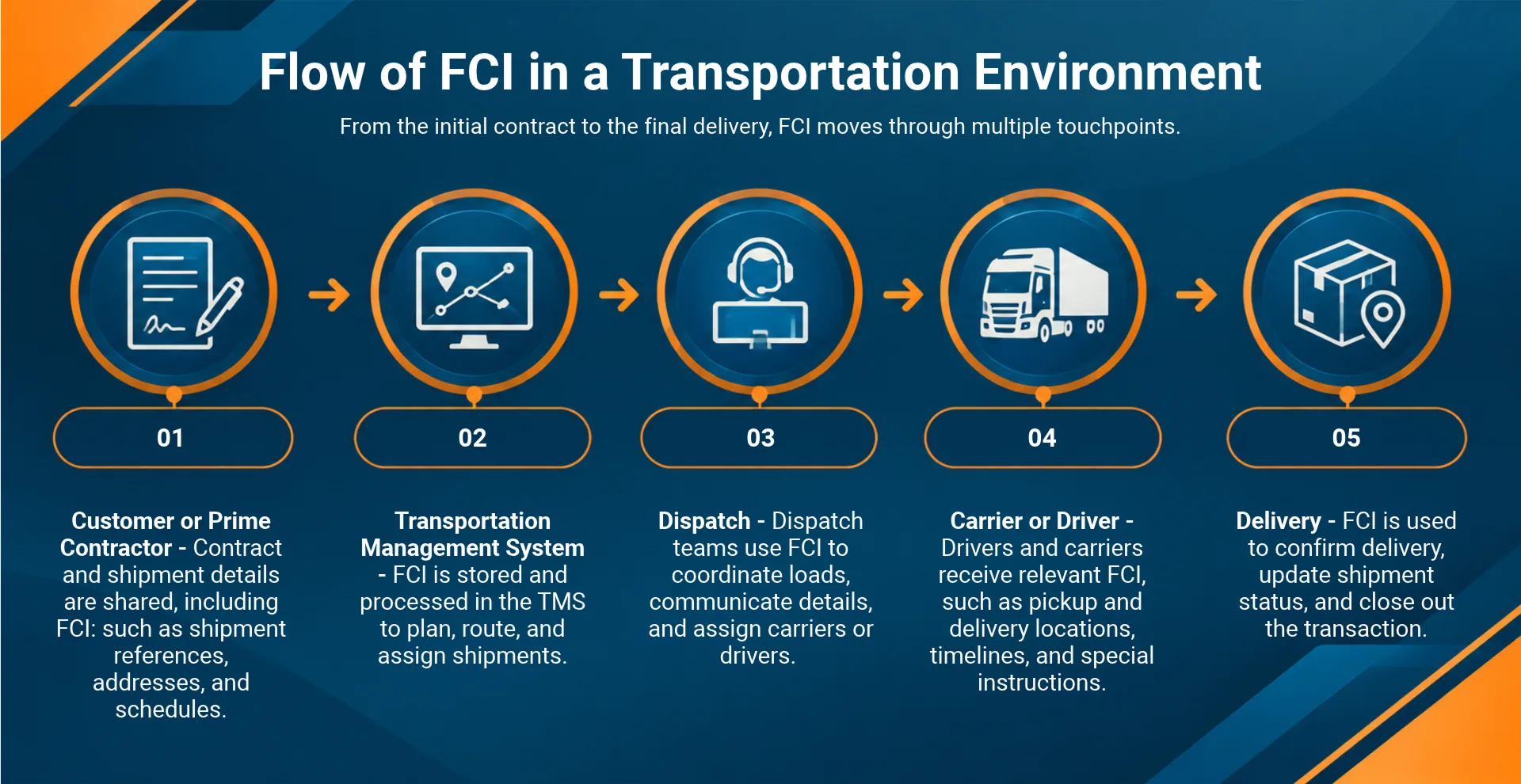
Every step is worth examining. That does not mean every application or device involved in the process automatically belongs in the CMMC scope. Instead, companies need to understand which systems process, store, or transmit FCI and which other systems support access to that information.
The CMMC Level 1 Assessment Guide provides guidance for determining the assessment scope and evaluating the systems and assets that need to be considered. For transportation companies, getting this boundary right can make a major difference. An overly broad scope can create unnecessary work, while an incomplete scope can leave relevant systems out of the picture.
Also Read: What CMMC Level 1 Requires of You
Remote Access and Mobile Devices Matter
Transportation does not happen from behind a desk. Dispatchers may work from different locations. Drivers may use smartphones or tablets. Managers may need access while traveling. Technology vendors may connect remotely to support software, equipment, or other systems. That makes remote access an important part of a Level 1 review.
If employees use laptops, tablets, handheld scanners, or smartphones to access systems within the assessment boundary, those devices need to be considered as part of the overall environment. Remote work and mobile operations are not unusual exceptions in transportation. They are part of how the industry works, so security practices need to account for them.
Third-Party Connections and Supply Chain Access
A transportation company may rely on numerous external parties, including carriers, brokers, warehouse partners, software providers, maintenance vendors, and managed IT providers. Some of these organizations may connect directly to business systems. Others may receive information through portals, email, file transfers, or application integrations.
The important question is what those relationships mean for your FCI environment. If a vendor has access to an in-scope system, that connection needs to be understood and controlled. If a third party receives FCI as part of performing a DoD subcontract, its own CMMC obligations may also need to be considered.
The CMMC rule applies to prime contractors and subcontractors throughout the supply chain when they process, store, or transmit FCI or CUI in performance of the applicable DoD contract or subcontract.
Also Read: CMMC Level 1 vs Level 2, Which Applies to You?
Common Level 1 Gaps in Transportation Environments
Transportation companies can have several practical challenges when preparing for Level 1.
- Shared accounts can make individual accountability difficult.
- Former employees or contractors may retain unnecessary access if account removal is not handled promptly.
- Unmanaged remote access can create additional exposure.
- Warehouse and mobile devices may receive less attention than corporate endpoints.
- Third-party integrations can make the assessment boundary harder to define.
- Documentation gaps can also create problems when actual security practices are not clearly documented.
The DoD recommends conducting a self-assessment against the applicable requirements and addressing unmet requirements before the assessment process.
How Logistics Companies Can Prepare for CMMC Level 1
A practical preparation process can begin with five steps.
- Review the contract: Determine whether the solicitation or contract requires CMMC Level 1 and identify any applicable flow-down requirements.
- Identify FCI: Document what FCI your organization receives, creates, stores, processes, or transmits while performing the contract.
- Map the environment: Identify the applications, systems, devices, facilities, users, and external connections associated with that information.
- Review the 15 requirements: Compare your existing practices against each Level 1 requirement and identify gaps.
- Organize your evidence: Maintain documentation that demonstrates how your security practices operate. Policies alone are not enough if actual practices do not match them. The Level 1 assessment methodology includes examination, interviews, and testing.
Moving Ahead
For logistics and transportation companies, CMMC Level 1 starts with understanding where FCI moves across dispatch systems, transportation platforms, workstations, mobile devices, email, remote connections, and third-party services. The 15 requirements provide a baseline for protecting that information, but readiness also requires accurate scoping, applicable safeguards, supporting evidence, and the required annual self-assessment and affirmation.
A practical starting point is to map your FCI, identify who can access it, and review the systems and connections supporting that access. A focused checklist can help your team review remote access and mobile device security and identify areas that may need attention.
Also Read: CMMC Level 1 Compliance, Handled End to End